Me (casually opening the SES Guidelines):
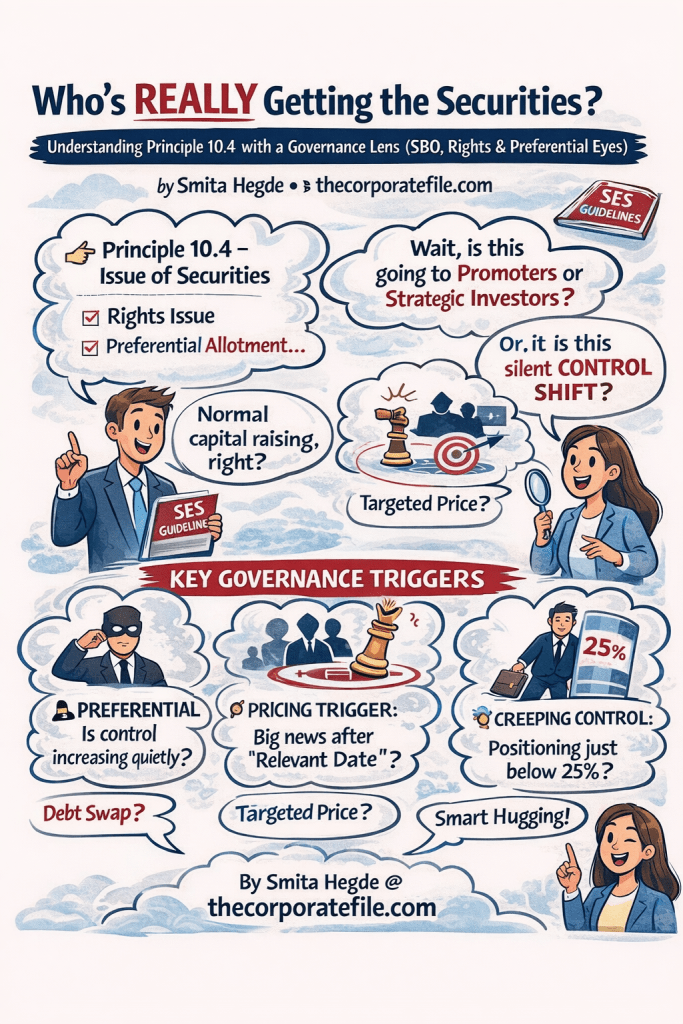
Alright… Principle 10.4 – Issue of Securities.
Rights issue, preferential allotment… standard capital raising.
source link
https://www.sesgovernance.com/assets/pdfs/proxy-advisory/1750172548_Proxy-Advisory-Guidelines_FY-2025-26_Website.pdf : Beyond Section 62: The Forensic Link Between SBO, SEBI SAST, and Security Issuancepage no.54
Me (reaching Question 7):
“Whether the issue is being made to promoters or strategic investors?”
…Okay. This is not routine.
This is where governance starts speaking.
The Conversation in My Head
Me 1 (compliance mode):
Check pricing ✔️
Check valuation report ✔️
Check approvals ✔️
Me 2 (governance mode):
Pause.
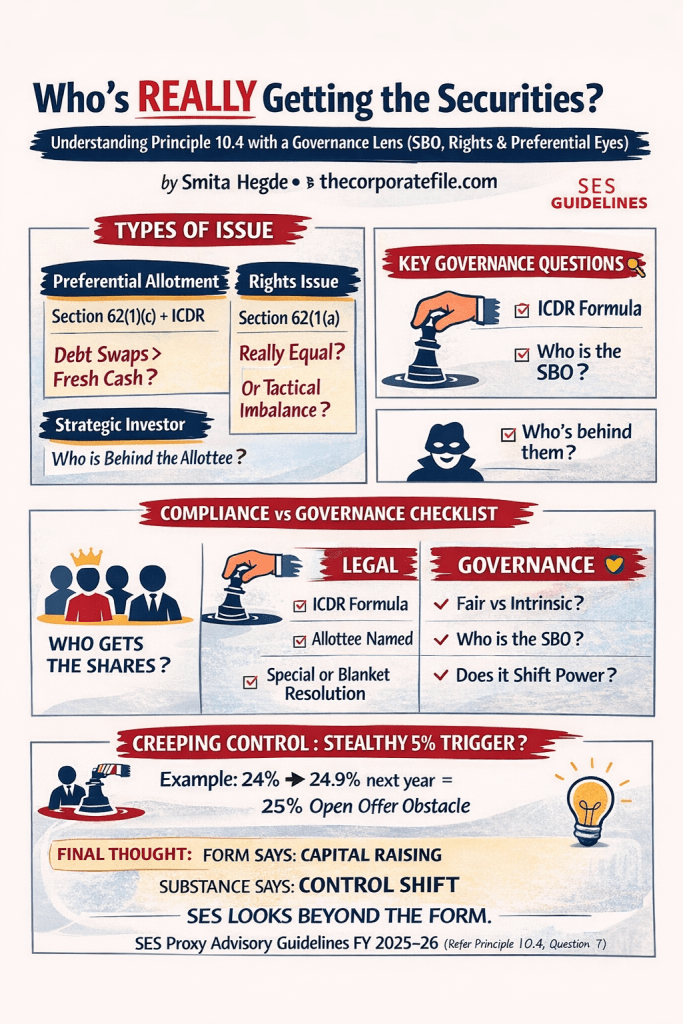
👉 Who is getting the shares?
Because that determines everything.
Layer 1: Preferential Allotment — The Silent Control Tool
Me:
Preferential issue is governed by:
- Section 62(1)(c) of the Companies Act, 2013
- Rule 13 of the Companies (Share Capital and Debentures) Rules, 2014
- Chapter V of the SEBI ICDR Regulations, 2018
Also me:
So yes — legally compliant.
But if allotted to promoters…
This could be:
- Increasing promoter stake quietly
- Structuring control below thresholds under SEBI SAST Regulations, 2011
- Diluting minority influence
👉 Not just capital raising — potential control engineering
🔍 Governance Lens 1: “Skin in the Game vs Free Ride”
- Fresh cash coming in? → genuine capital
- Debt conversion? → stake increase without liquidity
👉 If no real money enters → not growth, just control shift
🔍 Governance Lens 2: “Pricing Arbitrage”
- ICDR formula followed ✔️
- But timing manipulated ❓
👉 Good news after pricing = hidden discount to promoters
Layer 2: Rights Issue — Looks Fair, But Is It?
Me (relieved):
Rights issue = Section 62(1)(a) → offered to all shareholders.
Me (thinking deeper):
But what if:
- Promoters renounce strategically?
- Or subscribe disproportionately?
👉 End result:
- Promoter stake increases
- Minority diluted indirectly
🔍 Governance Lens 3: “Substance over Form”
- Form: Equal opportunity
- Substance: Control consolidation
Layer 3: Strategic Investors — The “Grey Zone”
Me:
Oh nice, a strategic investor is coming in.
Also me:
Wait… who exactly?
Because legally:
- Still falls under Section 62(1)(c) + ICDR
But governance-wise:
👉 Is this truly independent?
👉 Or a “friendly party”?
Enter the Real Game Changer: SBO (Significant Beneficial Ownership)
Me (now fully alert):
- Section 90 of the Companies Act, 2013
- SBO Rules, 2018
👉 Legal ownership ≠ Real ownership
🔍 Governance Lens 4: “Masked Allottee Risk”
Ask:
- Who is the ultimate beneficial owner (UBO)?
- Is there indirect promoter linkage?
👉 If unclear → assume control may be hidden
The Most Ignored Risk: Creeping Control
Me (connecting dots):
Under SEBI SAST Regulations, 2011:
- Promoters can increase up to 5% annually
But…
👉 24% → 24.9% = strategic positioning below 25% trigger
🔍 Governance Lens 5: “Creeping Control Calculator”
- Check post-issue voting power
- Not just % change
👉 Is this avoiding open offer intentionally?
The Hidden Red Flag: Blanket Resolutions
Me (frustrated):
“Approve issuance to any investor anytime”
👉 Legally valid
👉 Governance-wise dangerous
🔍 Governance Lens 6: “No Name, No Accountability”
If investor not identified:
👉 This is future dilution without transparency
Bringing It All Together — My Thought Flow
When I read this, I didn’t see a checklist.
I saw a forensic governance framework:
Step 1: Legal Structure
- Section 62 → issuance
- ICDR → pricing
- SAST → control
- SBO → ownership
Step 2: Governance Questions
- Who gets shares?
- Who gains control?
- Who is behind them?
The Real Governance Insight (This is the punchline 🔥)
Law checks compliance.
SES checks intention.
Summary Table (Compliance vs Governance)
| Feature | Legal Requirement | Governance Expectation |
| Pricing | ICDR Formula | Fair vs intrinsic value |
| Identity | Allottee name | SBO (real owner) |
| Method | Section 62 | Why not Rights Issue? |
| Control | SAST thresholds | De facto control shift |
When I Read This, I Thought Like This:
This one question connects:
- Section 62 → issuance
- ICDR → pricing
- SAST → control
- Section 90 → ownership
But SES…
👉 Asks one thing: Who really wins?
Source 📌
SES Proxy Advisory Guidelines FY 2025–26:
https://www.sesgovernance.com/assets/pdfs/proxy-advisory/1750172548_Proxy-Advisory-Guidelines_FY-2025-26_Website.pdf
(Refer: Principle 10.4 – Issue of Securities, Question 7)
Final Thought (Top Voice Mic Drop 🔥)
Form says: Capital Raising
Substance says: Control Transfer
And SES?
👉 SES reads substance.
Disclaimer: Prepared solely for academic and educational purposes. This does not constitute investment advice, professional consultation, or any recommendation
Connect on Linkedin www.linkedin.com/in/smita-hegde-90595b1b5


Leave a Reply