The Corporate File | Sector Brief
A governance-focused analysis of macro shocks, policy alignment, and corporate response
When the Honorable Prime Minister Narendra Modi compared today’s geopolitical environment to COVID-19, the signal was not about disruption.
It was about national preparedness and collective resilience.
It signalled a shift from event-based disruption to systemic vulnerability.
This is not a sectoral note on inflation.
It is an examination of how geopolitical risk restructures corporate decision-making, supply chains, and governance priorities.
For FMCG, the impact is immediate — because it sits at the core of consumption economics.
🔶 1. Sector Impact: From Inflation to Structural Exposure
FMCG is among the first sectors where geopolitical shocks translate into household impact.
- Crude-linked inputs — packaging, logistics — turn volatile
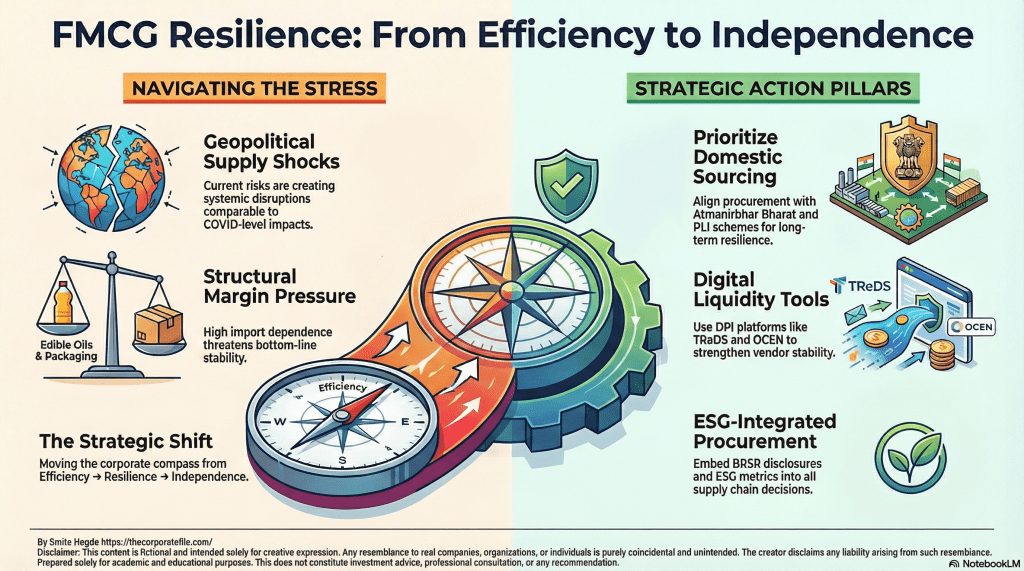
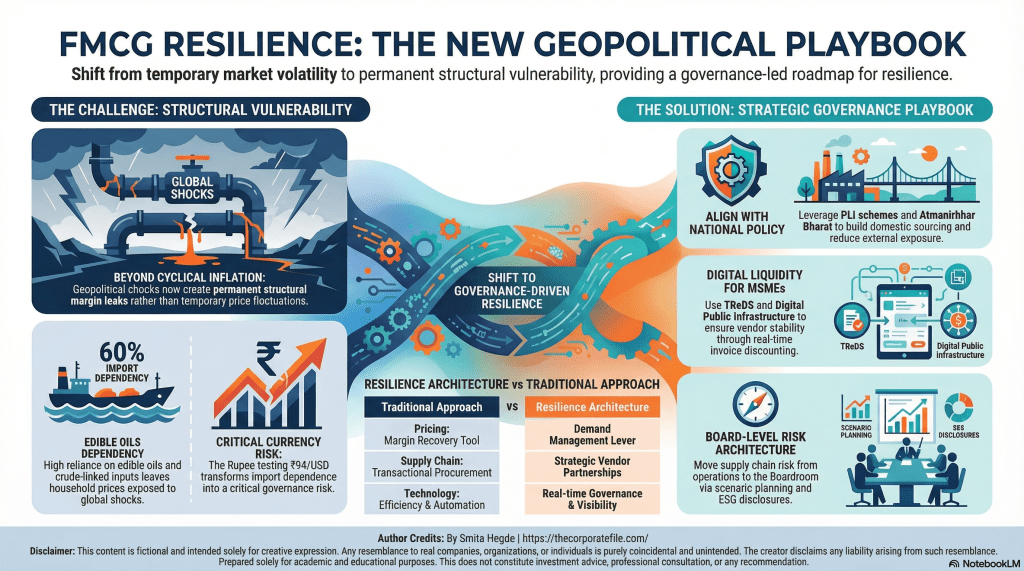
- Edible oil imports (India ~60% import-dependent) face global price shocks
- Freight and insurance costs rise
- Currency depreciation amplifies cost pressures
With the Rupee testing the ₹94/USD psychological band, import dependence is no longer a hedgeable fluctuation — it becomes a structural margin leak.
👉 Key Takeaway:
FMCG inflation is not cyclical — it is externally transmitted vulnerability.
🔶 2. Large Company Response: Protecting Demand Architecture
Large FMCG companies respond through calibrated strategies:
- Gradual and staggered price increases
- Shrinkflation to preserve affordability
- Multi-geography sourcing strategies
- Selective backward integration
- Premiumisation to maintain margins
The objective is not cost recovery alone — it is demand continuity in an inflation-sensitive economy.
👉 Key Takeaway:
Pricing in FMCG is a demand management lever — not just a margin tool.
🔶 3. MSME/SME Reality: Liquidity Architecture, Not Just Stress
The first breakdown appears within MSME ecosystems:
- Working capital cycles tighten
- Limited pricing power restricts cost pass-through
- Import-linked inputs disrupt cost structures immediately
- Buyer concentration increases vulnerability
This reflects a liquidity architecture gap, not merely operational stress.
Formalisation through Udyam Registration must be complemented with adoption of
Trade Receivables Discounting System — enabling invoice discounting and liquidity access.
👉 Key Takeaway:
MSME fragility is a liquidity system issue — not a scale issue.
🔶 4. ESG & CSR: From Narrative to Continuity Obligation
The ESG conversation in FMCG is shifting from intent to accountability.
Environmental (E)
- Reducing dependence on crude-linked packaging
- Transitioning toward sustainable material alternatives
Social (S)
- Ensuring workforce stability during demand fluctuations
- Institutionalising employee mental health and resilience systems
- Protecting frontline distribution workforce
Governance (G)
- Integrating commodity and supply chain risks into board oversight
- Strengthening scenario-based risk frameworks
Under disclosure regimes such as
SEBI BRSR Core:
Supply chain resilience is no longer a CSR narrative — it is a disclosed vulnerability metric
👉 Key Takeaway:
What was earlier internal risk is now external disclosure.
🔶 5. Policy Lens: From External Support to Strategic Design
The COVID comparison signals structural disruption.
India’s policy architecture offers alignment pathways:
- Atmanirbhar Bharat → reducing import dependence
- Production Linked Incentive Scheme → domestic capability creation
- Emergency Credit Line Guarantee Scheme → MSME liquidity support
The structural priority extends to:
- MSME vendor ecosystem strengthening
- Rural supply chain resilience
- Domestic agri and input sourcing
👉 Key Takeaway:
Policy is no longer support — it is supply chain architecture.
🔶 6. What Companies Should Do Now: A Governance & Boardroom Playbook
This is not an operational response.
It is a governance mandate.
🔹 Reframe Supply Chains as Strategic Risk
- Embed import dependence into ERM frameworks
- Mandate board-level Risk Committee review
- Institutionalise geopolitical scenario planning
🔹 Align Strategy with Policy Architecture
- Integrate sourcing with Atmanirbhar Bharat
- Align capex with Production Linked Incentive Scheme
- Strengthen MSMEs via Emergency Credit Line Guarantee Scheme
🔹 Redesign MSME Vendor Governance
- Move from transactional procurement to strategic partnerships
- Introduce vendor risk frameworks (liquidity, concentration, import dependence)
- Enable faster payments and credit access
🔹 Strengthen Human Capital Oversight
- Expand board/NRC oversight to workforce resilience
- Institutionalise employee mental health systems
- Align leadership metrics with people sustainability
🔹 Embed ESG into Decision Architecture
- Integrate environmental and supply chain considerations into procurement
- Formalise social responsibility toward employees and vendors
- Strengthen governance disclosures on risk exposure
🔹 Legal & Compliance Preparedness: Financial & Workforce Governance
Legal preparedness must integrate contracts, capital, and workforce frameworks.
Contractual Protection
- Strengthen force majeure and cost escalation clauses
Loan Structuring & Liquidity Governance
- Avoid over-reliance on short-term borrowing
- Align liquidity buffers with supply chain volatility
- Monitor currency-linked liabilities
Capital Allocation Discipline
- Shift toward resilience-driven capex
- Invest in domestic sourcing and backward integration
Labour Law & Employee Benefit Governance
- Align with labour codes (wages, social security, industrial relations)
- Ensure continuity of health, insurance, and workforce protection
- Stabilise frontline workforce exposed to demand shocks
Disclosure & Internal Controls
- Strengthen SEBI LODR risk reporting
- Expand internal audit to supply chain and vendor concentration risks
👉 Key Takeaway:
Compliance is no longer defensive — it is central to financial and operational continuity.
🔹 Build Structural Independence: Supply Chain Governance
This is not supply chain management — it is strategic control architecture.
- Invest in domestic sourcing ecosystems
- Develop multi-geography supplier networks
- Digitise supply chain visibility for board oversight
Additional Structural Levers:
- Strategic inventory buffers for critical imports
- MSME vendor capability development
👉 Key Takeaway:
Independence is achieved when no single disruption can destabilise the enterprise.
🔶 7. The Digital Dividend: Governance via Real-Time Architecture
To align with a “COVID-level preparedness” mindset, boards must move from periodic reporting to real-time governance systems.
🔹 DPI Integration into Governance
- Mandate integration of India’s digital public infrastructure into ERM frameworks
- Use platforms like
Open Credit Enablement Network
to provide on-demand (“flash”) liquidity to MSME vendors during disruptions
🔹 Predictive Compliance & Inventory Governance
- Deploy AI-led systems such as
VISTAAR
to monitor inventory levels and supply disruptions
This is not efficiency-led — it is a governance safeguard against:
- Hoarding risks
- Localised supply shocks
- Distribution imbalances
🔹 TReDS Evolution: From Discounting to Embedded Finance
- Expand use of
Trade Receivables Discounting System
toward B2B BNPL frameworks for last-mile distributors
👉 Transform distribution networks into financially resilient ecosystems, not just logistics chains.
👉 Key Takeaway:
In a geopolitical economy, the boardroom’s strongest defence is real-time visibility enabled by Digital Public Infrastructure.
🔶 Closing Insight: From Corporate Resilience to Viksit Bharat
When Narendra Modi draws a COVID parallel, the implication is clear:
This is not volatility — this is a restructuring of economic resilience.
A resilient FMCG sector is not merely a corporate advantage.
It is a shock absorber for the Indian economy.
In the journey toward Viksit Bharat,
strengthening consumption-linked sectors becomes foundational.
🔷 The Corporate File — Signature Metric
Resilience is not measured by how much a company grows in stability,
but by how little it fractures under stress.
Disclaimer: Prepared solely for academic and educational purposes. This does not constitute investment advice, professional consultation, or any recommendation
Connect on Linkedin www.linkedin.com/in/smita-hegde-90595b1b5


Leave a Reply