The Corporate File | Strategic Note
When the Honorable Prime Minister Narendra Modi compared today’s geopolitical environment to COVID-19, the signal was not about disruption.
It was about national preparedness and collective resilience.
It signalled a shift from event-based disruption to systemic vulnerability.This is not a sectoral note on inflation.
It is an examination of how geopolitical risk restructures corporate decision-making, supply chains, and governance priorities.
In defence, that signal is unmistakable:
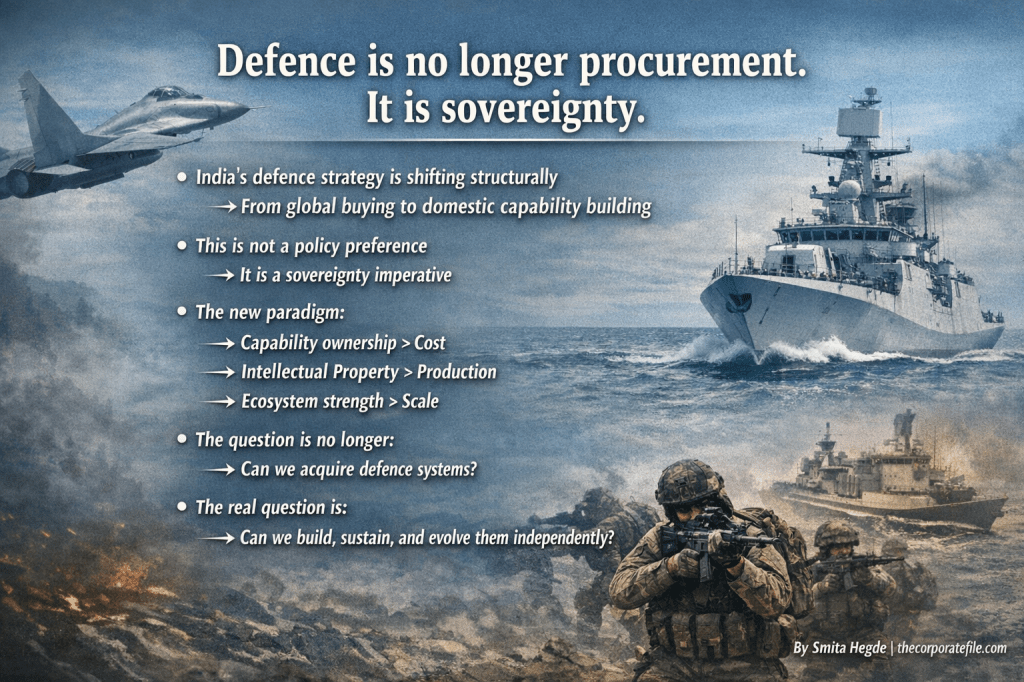
The era of buying security is over.
The era of building capability has begun.
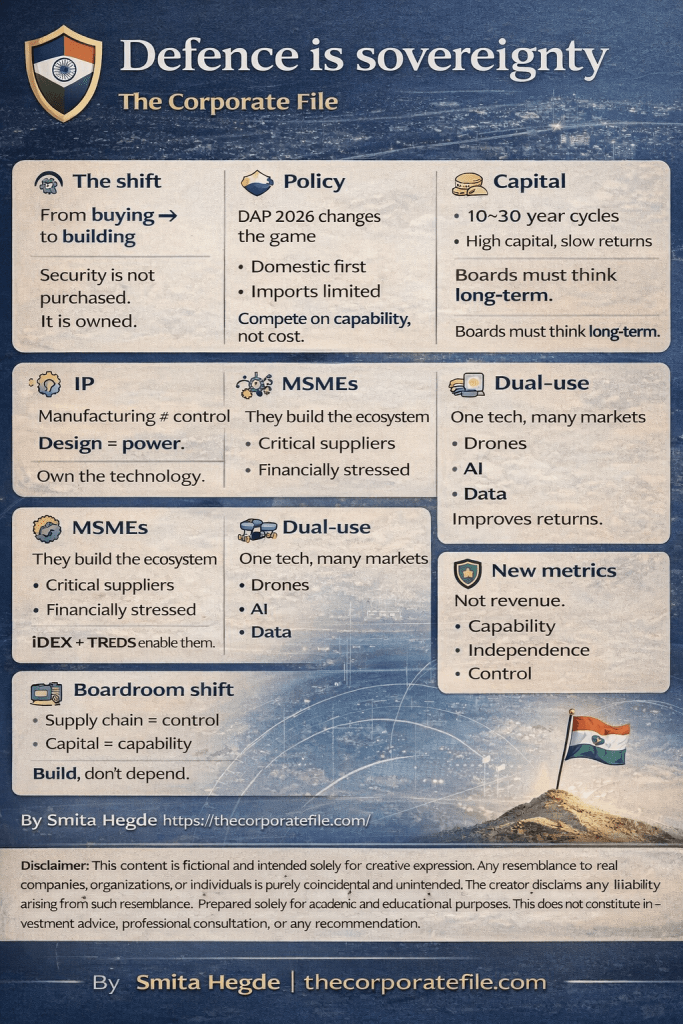
🔶 The Real Shift: From “Global Buy” to “Domestic Build”
India’s evolving procurement architecture, particularly through
Defence Acquisition Procedure 2026,
has fundamentally altered market logic:
If capability exists domestically, imports are no longer the default.
This is not a preference.
It is a structural policy direction.
The implication for companies is clear:
- You are no longer competing only on cost
- You are competing on capability ownership
🔶 Defence Is a Capital Discipline Game
Defence is a patient capital sector:
- Project cycles span 10–30 years
- Revenue visibility is delayed but stable
- Execution risk is high
- Capital intensity is significant
This requires a fundamental boardroom shift:
From quarterly performance tracking to multi-decade lifecycle governance
The real question is no longer:
- “What is the acquisition cost?”
It is:
- “Can we sustain and evolve this platform for decades?”
If the answer is uncertain, the capability is incomplete.
🔶 IP Is the Core of Strategic Power
In defence, production does not equal control.
Design authority does.
If:
- Core software is externally controlled
- System architecture is imported
- Upgrades depend on foreign entities
Then autonomy is constrained.
👉 Boards must treat Intellectual Property and Design Authority as non-negotiable priorities.
Strategic autonomy without IP control is not strategy — it is dependence in disguise.
🔶 MSMEs: The Invisible Defence Infrastructure
India’s defence ecosystem is built on distributed capability:
- MSMEs manufacture critical components
- They enable precision engineering at scale
- They form the backbone of supply chains
Yet they operate under:
- Liquidity stress
- Long receivable cycles
- Limited access to advanced technology
Platforms such as
Innovations for Defence Excellence
and
Trade Receivables Discounting System
are not support mechanisms — they are capability enablers.
A fragile MSME base is not a supplier issue.
It is a national capability risk.
🔶 Dual-Use Strategy: Extending Strategic Value
Resilient defence companies build beyond defence.
They develop dual-use technologies:
- Drones applied to agriculture and logistics
- Satellite intelligence applied to insurance and climate analytics
- AI systems deployed across industrial sectors
This approach:
- Enhances capital efficiency
- Reduces reliance on defence budget cycles
- Expands economic relevance
Dual-use capability transforms defence from a cost centre into a value multiplier.
🔶 Boardroom Reality: Governing Capability, Not Just Business
Defence companies operate at the intersection of policy, capital, and sovereignty.
Boards must therefore evaluate decisions differently:
- Supply chain choices → capability independence
- Capital allocation → long-term strategic control
- Vendor ecosystems → resilience of the entire system
Key questions shift to:
- Are we building or borrowing capability?
- Are we controlling technology or accessing it?
- Are we strengthening ecosystems or concentrating risk?
🔶 The New Governance Metric
The defence sector will not be judged by:
- Order book size
- Revenue growth
It will be judged by:
- Capability ownership
- Supply chain independence
- Technology control
🔶 Closing Insight: Defence as a Sovereign Pillar
When Narendra Modi speaks of COVID-level preparedness,
he is pointing toward a future where nations must withstand disruption independently.
In that future:
Defence is not a sector.
It is the foundation of sovereign strength.
For India, this is central to the vision of Viksit Bharat.
🔷 The Corporate File — Signature Metric
A nation is not secure because it can buy defence systems.
It is secure because it can build, sustain, and evolve them independently.
Disclaimer: Prepared solely for academic and educational purposes. This does not constitute investment advice, professional consultation, or any recommendation.
Connect on Linkedin www.linkedin.com/in/smita-hegde-90595b1b5


Leave a Reply