The Corporate File | Strategic Note
When the Honorable Prime Minister Narendra Modi compared today’s geopolitical environment to COVID-19, the signal was not about disruption.
It was about national preparedness and collective resilience.
In the gas sector, that signal is unmistakable:
The era of assuming stable energy flows is over.
The era of building resilient energy systems has begun.
🔶 The Real Shift: From “Fuel Source” to “Economic Backbone”
Gas is no longer a transition fuel in India’s growth narrative.
It is now embedded into the core of economic functioning:
• Household energy (PNG, CNG)
• Fertilizer production (food security)
• Power generation (grid balancing)
• Industrial fuel (cost competitiveness)
India’s push toward a gas-based economy is not environmental positioning alone.
👉 It is a macroeconomic stabilisation design.
Because:
• Gas pricing directly impacts inflation
• Supply disruptions immediately affect multiple sectors
🔶 War Changes Everything: From Supply Chains to Household Budgets
Global conflicts no longer remain geopolitical events.
They translate into economic shocks through energy systems.
In gas markets:
• LNG cargoes are diverted
• Shipping risks increase
• Spot prices become volatile
Macro Impact:
• Rising import bills
• Currency pressure
• Inflationary trends
Consumer Impact:
• Higher CNG and PNG prices
• Increased electricity tariffs
• Rising food prices (fertilizer linkage)
👉 War is no longer distant.
It is reflected in both balance sheets and household budgets.
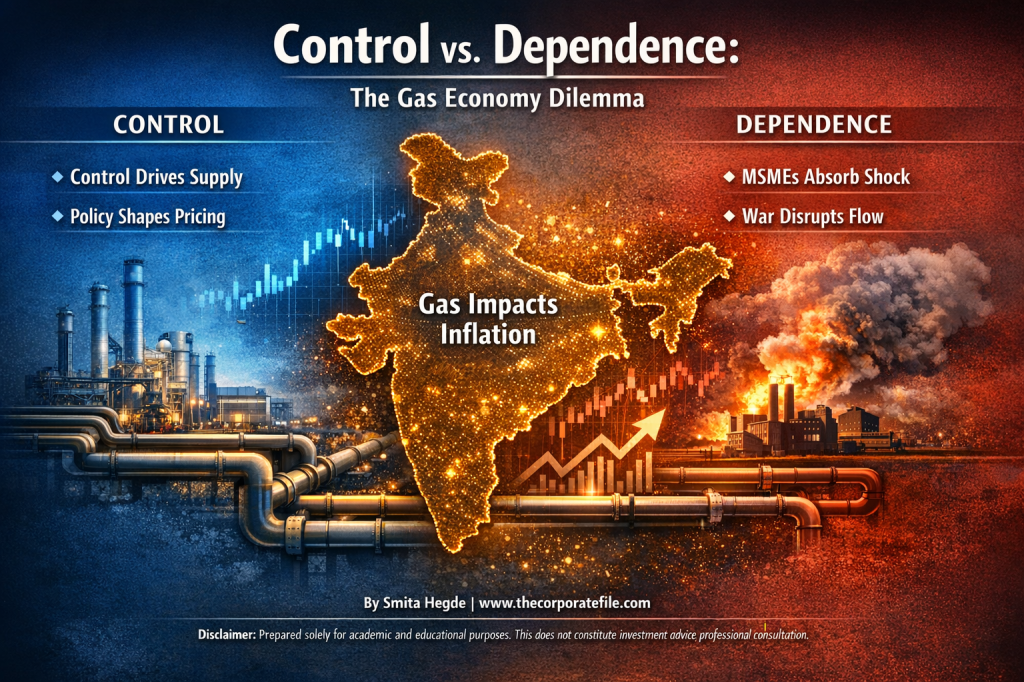
🔶 The Structural Divide: Control vs Dependence
The gas ecosystem operates on a fundamental asymmetry:
Supply Controllers:
• Exploration & production companies
• LNG importers
• Pipeline and infrastructure owners
Gas Dependents:
• Fertilizer companies
• Power generators
• City gas distributors
• MSMEs and industrial clusters
👉 One side governs access and pricing
👉 The other absorbs volatility and margin compression
This is not a sectoral feature.
It is a governance reality.
🔶 PSU, Private, MSME: Unequal Resilience Across the System
PSUs:
• Policy-aligned
• Access to long-term contracts
• Infrastructure control
Private Players:
• Agile sourcing strategies
• Portfolio-based risk management
MSMEs:
• Highly price-sensitive
• Limited hedging ability
• Direct exposure to volatility
👉 MSMEs do not just consume gas.
They absorb systemic shocks.
A fragile MSME base is not a supply issue.
It is a macroeconomic vulnerability.
🔶 ESG Reality: Transition Fuel or Strategic Dependence?
Gas has been positioned as a cleaner alternative.
But governance questions are intensifying:
• Import dependence vs sustainability narrative
• Price volatility vs affordability
• Methane emissions vs transition benefits
👉 The ESG lens is shifting:
From “Is gas cleaner?”
To “Is gas controllable and resilient?”
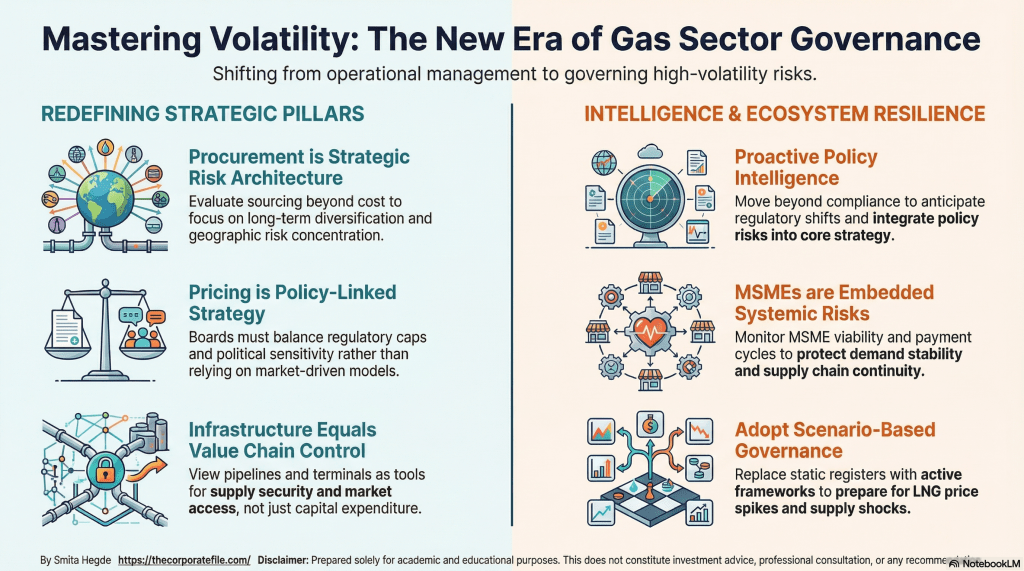
🔶 Boardroom Reality: Governing Volatility, Not Just Operations
Gas businesses no longer operate in predictable environments.
They operate within a system influenced by:
• Geopolitics
• Policy intervention
• Currency fluctuations
• Infrastructure constraints
This demands a structural shift in governance:
1. Procurement as Strategic Risk Architecture
Boards must evaluate sourcing beyond cost:
• Long-term contracts vs spot exposure
• Supplier diversification
• Geographic risk concentration
👉 Procurement is no longer transactional.
It is a risk management framework.
2. Pricing Governance Under Policy Constraints
Gas pricing is not fully market-driven.
Boards must navigate:
• Regulatory caps (CGD, fertilizers)
• Political sensitivity of price increases
• Demand elasticity
👉 Pricing is not just financial.
It is policy-linked decision-making.
3. Infrastructure as Control, Not Just Capacity
Pipelines, LNG terminals, and distribution networks define:
• Market access
• Supply security
• Competitive positioning
Boards must assess:
• Single-point failures
• Integration across value chain
• Strategic redundancy
👉 Infrastructure is not capex.
It is control over the value chain.
4. Policy Intelligence as a Core Governance Layer
The gas sector is deeply policy-driven:
• Allocation priorities
• Pricing frameworks
• Subsidy structures
Boards must move from reactive compliance to proactive alignment:
• Tracking regulatory shifts
• Anticipating policy direction
• Integrating policy risk into strategy
👉 Policy awareness is not advisory.
It is board-level intelligence.
5. MSME Ecosystem as a Governance Variable
Gas-dependent MSMEs influence:
• Demand stability
• Supply chain continuity
• Employment generation
Boards must evaluate:
• Supplier viability
• Payment cycles
• Cost pass-through capacity
👉 MSME stress is not external.
It is embedded systemic risk.
6. Scenario-Based Governance (War, Supply Shock, Currency)
Static risk registers are no longer sufficient.
Boards must build scenario frameworks for:
• LNG price spikes
• Supply disruptions
• Currency depreciation
👉 Governance must shift from reporting to preparedness.
🔶 The New Governance Metric
The gas sector will not be judged by:
• Volume growth
• Network expansion
It will be judged by:
• Supply security
• Pricing resilience
• Policy alignment
• Ecosystem stability
🔶 Closing Insight: Gas as an Economic Shock Transmitter
Gas connects multiple layers of the economy:
Energy → Industry → Food → Inflation → Policy
Any disruption flows through this entire chain.
When Narendra Modi emphasised preparedness,
the message was clear:
Resilience must be built into systems — not assumed.
In that reality:
Gas is not just an energy input.
It is a transmission mechanism of economic stability.
🔷 The Corporate File — Signature Metric
An economy is not stable because it has access to gas.
It is stable because it can secure, price, and govern gas without disruption.
Disclaimer: Prepared solely for academic and educational purposes. This does not constitute investment advice, professional consultation, or any recommendation
Connect on Linkedin www.linkedin.com/in/smita-hegde-90595b1b5
IndiaEnergy, CorporateStrategy, SupplyChainResilience, Geopolitics, GasEconomy, MSME, PublicPolicy, RiskManagement,


Leave a Reply