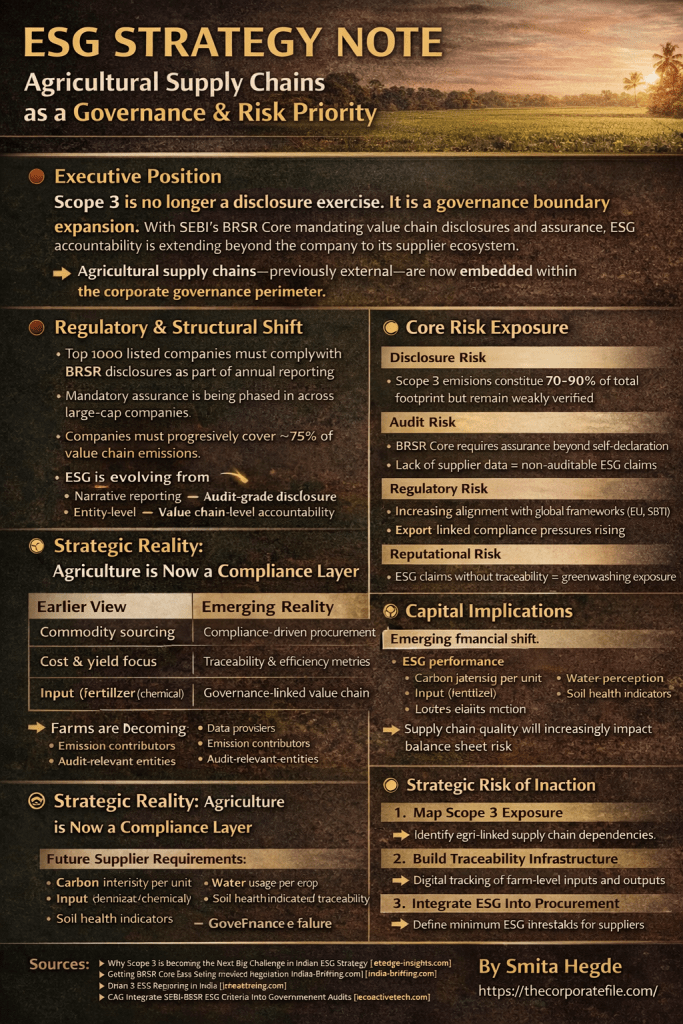
Reading ESG Signals from Supply Chains to Soil
📊 The Real Story Behind ESG Disclosures
Across the Nifty 50, ESG disclosures are no longer narrative—they are becoming decision frameworks.
At a surface level, companies report:
- Emission reductions
- Water efficiency
- Sustainability commitments
But structurally, something more significant is happening:
The accountability for ESG is being transferred upstream—into supply chains.
For agriculture, this is the inflection point.
👉 Farms are no longer external to governance systems.
They are becoming embedded compliance nodes.
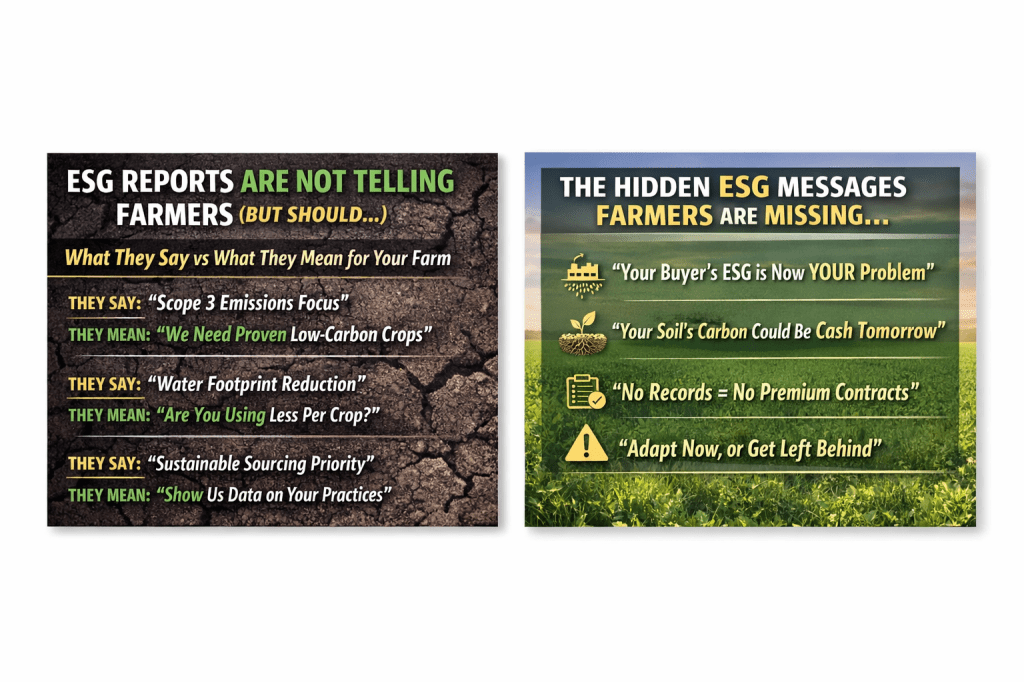
🧭 From ESG Reporting to Procurement Power
Global corporations such as Nestlé and General Mills are no longer sourcing purely on price or volume.
They are sourcing on:
- Verifiable sustainability
- Traceability
- Carbon footprint
- Resource efficiency
This creates a structural redefinition:
Agriculture is shifting from a commodity business to a compliance-driven ecosystem.
🌾 Regenerative Agriculture: From Practice to Strategic Infrastructure
At the operational level, regenerative agriculture improves soil.
At the strategic level, it does something more critical:
It converts the farm into a resilient, self-regulating system that aligns with ESG mandates.
This is not a technique shift.
It is a system redesign.
📉 The Metric Shift: From Yield to Efficiency
Traditional agriculture optimized:
- Yield per acre
The ESG-aligned system optimizes:
- Return per unit of input
This reframes decision-making:
Yield without efficiency is not productivity—it is disguised cost.
Top operators now track:
- Input cost vs marginal yield
- Water per unit output
- Fertilizer efficiency
👉 The objective is not maximum output, but maximum efficiency at stable soil health.
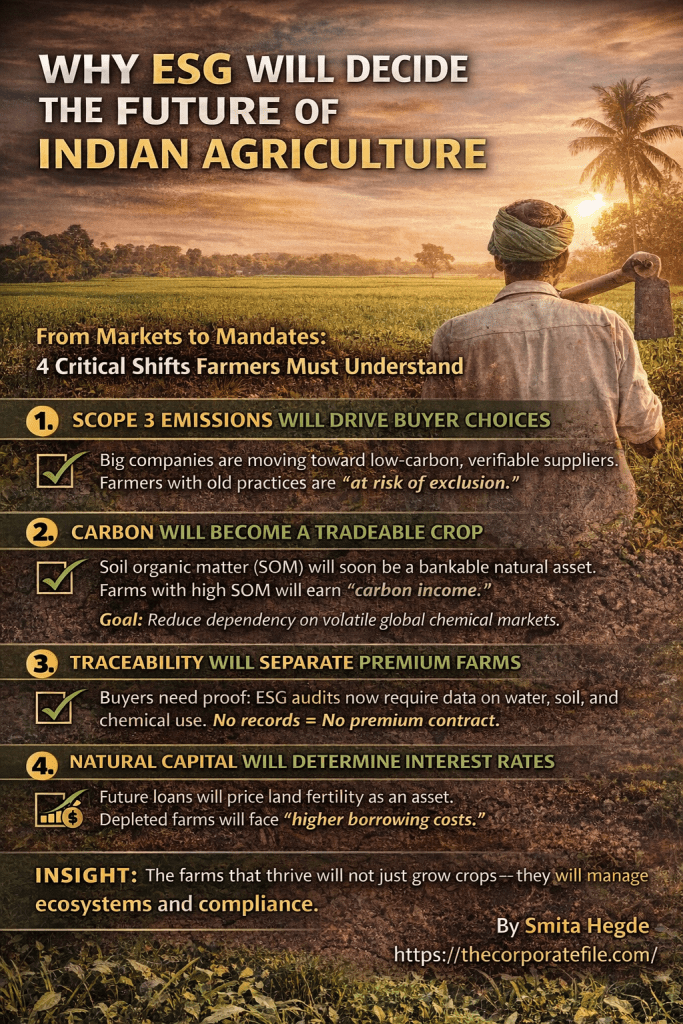
🌍 Natural Capital: Expanding the Balance Sheet of the Farm
The most important shift—yet least discussed—is this:
The farm is no longer just an income-generating unit. It is an appreciating asset.
Elite operators are moving toward Natural Capital Accounting.
By increasing:
- Soil Organic Matter (SOM)
- Biological activity
- Carbon content
…you are not just improving yield—you are increasing the intrinsic value of your land.
A farm with 4% SOM is not just more productive—it is more financeable, more resilient, and more valuable.
Looking forward:
- Credit markets will price soil quality
- Lending risk will reflect land health
- Asset valuation will include biological strength
👉 Regenerative agriculture becomes balance sheet expansion—not just operational improvement.
🧬 Biological Systems as Risk Architecture
Conventional farming externalizes risk:
- Fertilizer dependence
- Chemical reliance
- Climate vulnerability
Regenerative systems internalize stability.
By strengthening:
- Microbial ecosystems
- Soil food webs
- Organic nutrient cycles
…the farm develops:
✔ Drought resistance
✔ Pest resilience
✔ Input independence
🛡️ The Biological Hedge Against Inflation
The most underappreciated advantage of regenerative agriculture is financial:
It is a hedge against input inflation and geopolitical risk.
Modern farming is exposed to:
- Global urea prices
- Natural gas volatility
- Supply chain disruptions
By shifting toward:
- Nitrogen-fixing crops
- Microbial fertilizers
- Organic inputs
…you decouple from volatile external markets.
👉 You replace:
- Variable external costs
with - Stable internal biological assets
This is not sustainability.
This is strategic risk management.
📲 The Data Layer: Closing the “Data-Yield Gap”
The future of agriculture is not just biological—it is data-verified.
The “Glass Farm” concept becomes critical here:
If it cannot be measured, it cannot be monetized.
However, not all data matters.
📊 The KPIs That Define Future Market Access
To align with ESG-driven procurement, farms must track:
- Nitrogen Use Efficiency (NUE)
→ Yield per unit of nitrogen applied - Water Productivity Index
→ Output per cubic meter of water - Carbon Intensity Score
→ Emissions per ton of harvest
These are not technical metrics.
They are becoming:
👉 Gatekeeping metrics for global supply chains
📦 Traceability: Where Governance Meets the Farm
ESG systems require one core principle:
Auditability
This translates into:
- Input logs
- Water usage tracking
- Crop lifecycle documentation
This creates the “Glass Farm”:
A system where:
- Every activity is recorded
- Every claim is verifiable
👉 This enables:
- Direct market access
- Premium pricing
- Institutional trust
⚠️ The Strategic Risk of Non-Alignment
This transition is not immediate—but it is inevitable.
Over time:
- Procurement filters will tighten
- Export standards will rise
- ESG-linked sourcing will dominate
Farms that cannot demonstrate sustainability will not collapse—
they will simply be bypassed.
🚀 Strategic Audit: Is Your Farm ESG-Ready?
Top 1% operators do not guess—they audit.
The Agribusiness Strategic Audit
- Baseline
Do you have a certified soil carbon and biodiversity baseline within the last 12 months? - Traceability
Can you provide a digital record of every input used for a specific crop cycle? - Efficiency
Is your Nitrogen Use Efficiency (NUE) improving year-on-year? - Risk Exposure
What percentage of your fertility is:- Biological (internal)?
- Synthetic (external)?
💬 Closing Insight
“The average farmer manages for the harvest.
The strategic farmer manages for the system.
The elite agribusiness leader manages for the balance sheet.”
🌱 Final Takeaway
Regenerative agriculture is no longer:
- A sustainability initiative
- A niche farming method
It is emerging as:
👉 A governance requirement
👉 A capital allocation strategy
👉 A market access filter
The shift is clear:
The future of agriculture will not be decided in the field alone—
but at the intersection of soil, data, and capital.
Disclaimer: This content is fictional and intended solely for creative expression. Any resemblance to real companies, organizations, or individuals is purely coincidental and unintended. The creator disclaims any liability arising from such resemblance. Prepared solely for academic and educational purposes. This does not constitute investment advice, professional consultation, or any recommendation
Connect on Linkedin www.linkedin.com/in/smita-hegde-90595b1b5
 The Corporate File
Leave a comment