Most boards don’t collapse.
They slowly become irrelevant.
And the warning signal is already there —
hidden in something as simple as age.
Yet, Indian corporate law remains silent on it.
📊 Why Age of Directors Is a Governance Signal
The SES Proxy Advisory Guidelines FY 2025–26 take a position that most companies ignore:
- Age of individual directors
- Average age of the board
are not just demographic data points —
they are indicators of succession preparedness.
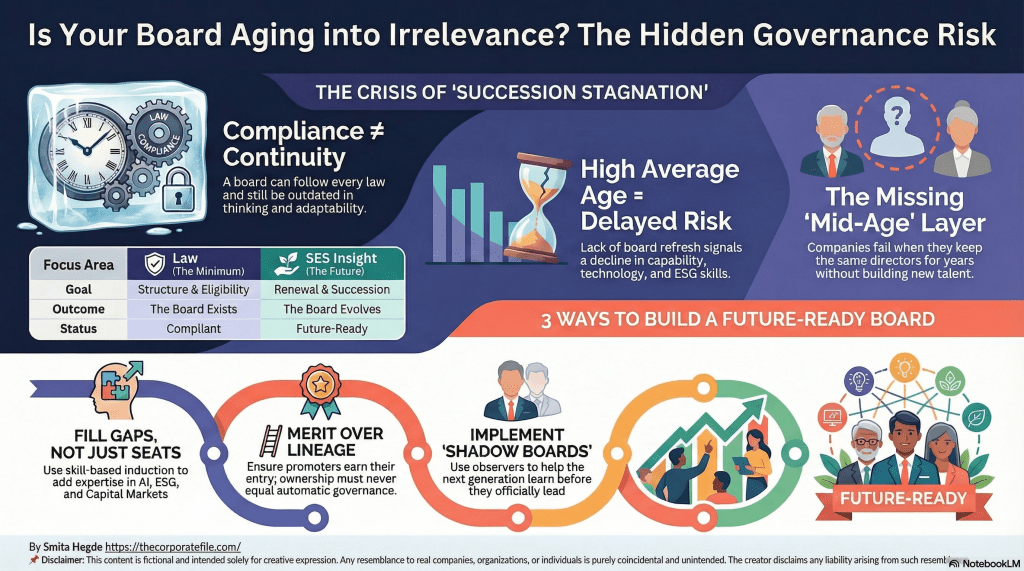
A high average age without board refreshment is not stability.
It is delayed risk.
⚖️ Where the Law Stands vs What SES Adds
📜 Where the Law Stands
Under the Companies Act, 2013:
- Section 149 → Defines board composition and independent directors
- Section 152 → Appointment, reappointment, and retirement by rotation
Under SEBI (LODR) Regulations, 2015:
- Regulation 17 → Board composition
- Regulation 25 → Role of independent directors
- Schedule II → Nomination & Remuneration Committee (NRC)
The law ensures:
✔ Structure
✔ Eligibility
✔ Process
⚡ What SES Adds
SES introduces a future-readiness test:
✔ Is the board renewing itself?
✔ Is there generational diversity?
✔ Is succession visible, not assumed?
Because a compliant board can still be a declining board.
🧩 The Core Governance Gap
Law governs entry and structure.
It does not govern transition and continuity.
This creates a silent risk:
Boards remain valid on paper,
but weak in long-term sustainability.
❌ Where Companies Get It Wrong
- Over-reliance on long-tenured directors
- Reappointment without performance or transition logic
- NRC acting as a compliance checkpoint, not a pipeline builder
- No structured onboarding of next-generation talent
The result:
✔ Experience retained
✖ Continuity compromised
🏢 A Real Governance Scenario
A company may comply with:
✔ Section 149
✔ Regulation 17
Yet internally:
- Average board age: 66+
- No new directors in 5 years
- Same leadership loop
This is not stability.
This is succession stagnation.
🔥 The Real Issue: Entry of the Next Generation
Succession planning fails not because of age —
but because entry of the next generation is unstructured.
And this is where governance collapses silently.
🚀 5 Governance-Grade Ways to Introduce the Next Generation
1️⃣ Structured Pipeline via NRC (Not Informal Entry)
- Promoter companies: Avoid direct board entry of family members
- Non-promoter companies: Build leadership pipeline through CXO-level grooming
👉 Entry should be through evaluation, not lineage or convenience
2️⃣ Mandatory Skill-Based Qualification Mapping
Before induction, define:
- What skill gap exists on the board?
- Does the incoming member fill it?
Critical future skills:
- Technology & AI oversight
- ESG and sustainability
- Global capital markets
👉 Next-gen should solve a board problem, not occupy a seat
3️⃣ Shadow Board / Observer Role (Transition Layer)
Introduce next-gen as:
- Board observers
- Committee invitees
- Strategy participants
This allows:
✔ Learning without voting power
✔ Gradual exposure
✔ Performance visibility
4️⃣ Age + Skill Diversity Matrix Disclosure
Boards should internally track:
- Age distribution
- Skill distribution
- Tenure layering
👉 A 65+ average age board with no mid-level layer is a design failure
5️⃣ Separation of Ownership vs Governance (Critical for Promoters)
In promoter-driven companies:
- Ownership ≠ automatic board eligibility
- Next-gen must earn board position via:
- Experience
- External exposure
- Measurable competence
👉 Otherwise, governance becomes hereditary, not meritocratic
🧠 The Skills Problem No One Talks About
Most boards are ageing in capability, not just age.
Common gaps:
- Digital understanding
- AI governance
- Cyber risk oversight
- ESG integration
Without new skill infusion:
The board may exist —
but it stops being strategically relevant.
🔍 The Strategic Interpretation
SES is not commenting on age.
It is exposing a deeper issue:
Boards are not designed for continuity.
⏳ Why This Matters Now
Modern governance requires:
- Speed
- Adaptability
- Forward-looking oversight
An ageing, unrefreshed board becomes:
→ Reactive
→ Slow
→ Strategically weak
🧾 Closing Insight
The Companies Act ensures boards exist.
SEBI LODR ensures they are structured.
SES asks the uncomfortable question:
Is this board built to outlast its current members?
🎯 Final Takeaway
Age is visible.
Succession failure is not — until it’s too late.
Part of the series: SES Proxy Advisory Guidelines — Clause-by-Clause Analysis
Disclaimer: This content is fictional and intended solely for creative expression. Any resemblance to real companies, organizations, or individuals is purely coincidental and unintended. The creator disclaims any liability arising from such resemblance.
Connect on Linkedin www.linkedin.com/in/smita-hegde-90595b1b5


Leave a Reply