⏱️ Reading Time: 6 minutes
“What We Chose to Protect”
The grandfather placed the report on the table.
“Everything you see here,” he said,
“was not written for reporting.”
“It was written for survival… for a legacy built over more than a hundred years.”
He paused, then looked at the child.
“Businesses are not remembered for how they were built…
but for how they were protected.”
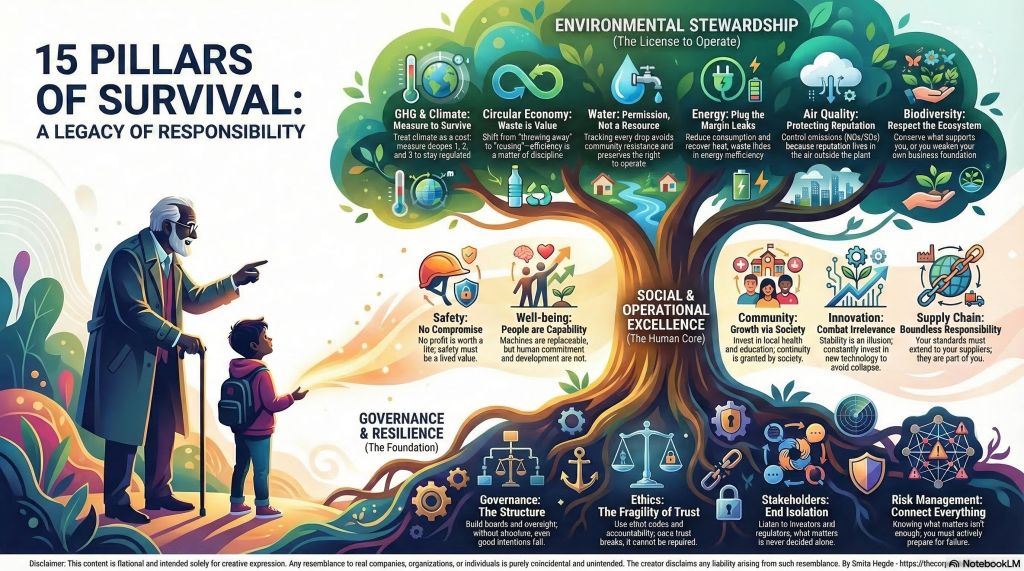
The child looked at the numbered list.
“Why these 15?”
The grandfather replied,
“Because these 15 can decide whether we continue… or disappear.”
1. Greenhouse Gas Emissions and Climate Change Management
“We realised early,” he said,
“that the air is no longer free.”
“What we release today… comes back as regulation tomorrow.”
“So we began to measure everything — Scope 1, Scope 2, Scope 3.”
“Because if climate turns into cost,” he paused,
“unprepared businesses don’t survive.”
2. Circular Economy / Recycling of By-products
He picked up a piece of scrap.
“This is not waste.”
“This is value… waiting to be understood.”
“So we stopped throwing things away.”
“We started reusing, recycling, and earning from what others discard.”
“Because efficiency is not innovation,” he said,
“it is discipline.”
3. Water Consumption and Effluent Discharge
They walked near a water source.
“This,” he said, “is not a resource.”
“It is permission.”
“If we take more than we return… we lose the right to operate.”
“So we tracked every drop.”
“We treated, reused, and replenished.”
“Because communities don’t resist factories,” he said,
“they resist injustice.”
4. Energy Efficiency / Energy Management
The child asked, “Why reduce energy?”
The grandfather smiled.
“Because waste hides in energy.”
“You don’t see it… but you pay for it.”
“So we reduced consumption, recovered heat, and changed our energy mix.”
“Margins don’t fall suddenly,” he said,
“they leak through inefficiency.”
5. Air Pollution / Air Quality Management
He looked at the horizon.
“There was a time when smoke meant growth.”
“That time is over.”
“So we controlled emissions — dust, NOx, SOx.”
“Because the air outside the plant…”
“…is where our reputation lives.”
6. Biodiversity
The child looked confused.
“Why should a business care about forests?”
The grandfather replied,
“Because destruction is easy… restoration is not.”
“So we learned to conserve, restore, and respect the ecosystem.”
“Because if you damage what supports you,” he said,
“you weaken your own foundation.”
7. Occupational Health and Safety
He became serious.
“This is where there is no compromise.”
“No target, no profit, no deadline…”
“…is worth a life.”
“So we built systems, tracked injuries, enforced discipline.”
“Because safety is not a policy,” he said,
“it is a value that shows in behaviour.”
8. Employee Well-being and Development
They watched employees leaving.
“They are not ‘resources’,” he said.
“They are capability.”
“So we trained, supported, and developed them.”
“Because machines can be replaced,” he said,
“commitment cannot.”
9. Community Support and Building Thriving Communities
They passed a nearby village.
“This is where our future is decided.”
“If they grow, we grow.”
“If they resist, we stop.”
“So we invested in education, health, and livelihoods.”
“Because continuity,” he said,
“is granted by society, not strategy.”
10. R&D, Technology, Product and Process Innovation
The child pointed to machinery.
“Why keep changing things?”
The grandfather replied,
“Because stability is an illusion.”
“So we kept investing in technology, new products, new processes.”
“Because industries don’t collapse in a day,” he said,
“they become irrelevant slowly.”
11. Supply Chain Sustainability
“Dada, what about those who supply to us?”
He answered,
“They are part of us.”
“So we ensured they follow standards, reduce emissions, act responsibly.”
“Because your responsibility…”
“…does not end at your boundary.”
12. Corporate Governance
The child asked quietly,
“What holds everything together?”
The grandfather replied,
“Structure.”
“So we built boards, committees, systems, oversight.”
“Because without governance,” he said,
“even good intentions fail.”
13. Business Ethics, Integrity and Transparency
He paused before speaking.
“This is the most fragile.”
“So we created codes, reporting systems, accountability.”
“Because once trust breaks,” he said,
“nothing else can repair it.”
14. Stakeholder Engagement
The child flipped back.
“Why ask everyone?”
The grandfather smiled.
“Because we don’t operate alone.”
“So we listened — investors, employees, communities, regulators.”
“Because what matters…”
“…is not decided in isolation.”
15. Risk Management
Finally, the child pointed at the last one.
“This… is separate?”
The grandfather shook his head.
“This connects everything.”
“Every issue you saw…”
“…can fail.”
“So we measured risk, tracked it, reviewed it.”
“Because knowing what matters is not enough,” he said,
“you must prepare for what can go wrong.”
The Last Line
The grandfather closed the report.
“These 15 are not priorities,” he said.
“They are responsibilities.”
“And if you ever lead this…”
he looked at the child and said:
“Do not ask what will grow the business.”
“Ask what can destroy it — and protect that first.”
He paused, then spoke more firmly:
“If emissions are ignored — regulation will shut you down.”
“If safety is ignored — one incident will stop everything.”
“If governance is weak — trust will disappear overnight.”
The child listened closely.
The grandfather continued:
“So remember this as your formula—”
“What can stop us?”
“Where are we most exposed?”
“And what are we doing about it today?”
He leaned forward and said:
“Because businesses don’t fail from lack of growth…”
“They fail from risks they chose to ignore.”
Disclaimer: This content is fictional and intended solely for creative expression. Any resemblance to real companies, organizations, or individuals is purely coincidental and unintended. The creator disclaims any liability arising from such resemblance.
Connect on Linkedin www.linkedin.com/in/smita-hegde-90595b1b5


Leave a Reply