Succession Planning in Corporate Governance: How Leadership Pipelines Are Built
Insights from the Godrej Consumer Products Limited Annual & Integrated Report 2024–25
⏱️ Reading Time: 6 minutes
At a Glance
How do large companies prepare for leadership transitions before they happen?
The Godrej Consumer Products Limited Annual & Integrated Report 2024–25 offers an interesting glimpse into how leadership pipelines are built.
Because when a key leader steps down, the real question is not who leaves —
it is who is ready to lead next.
The Hidden Risk Behind Leadership Transitions
A company’s biggest risk is rarely written on its balance sheet.
It appears when a leader leaves and the organisation suddenly realises no one is ready to step in.
This is why succession planning is no longer merely an HR exercise.
It has become a core pillar of corporate governance and institutional continuity.
Leadership continuity determines whether an organisation navigates transitions smoothly or experiences disruption at critical moments.
Leadership Continuity: A Governance Imperative
Succession planning often appears in annual reports as a short governance disclosure.
Yet behind this brief disclosure lies one of the most important questions every organisation must answer:
Who leads tomorrow?
Leadership transitions are inevitable in every institution. What determines organisational stability, however, is not the transition itself but the preparedness of the leadership pipeline.
The Godrej Consumer Products Limited Annual & Integrated Report 2024–25 illustrates how succession planning is approached as a structured leadership development process supported by governance oversight.
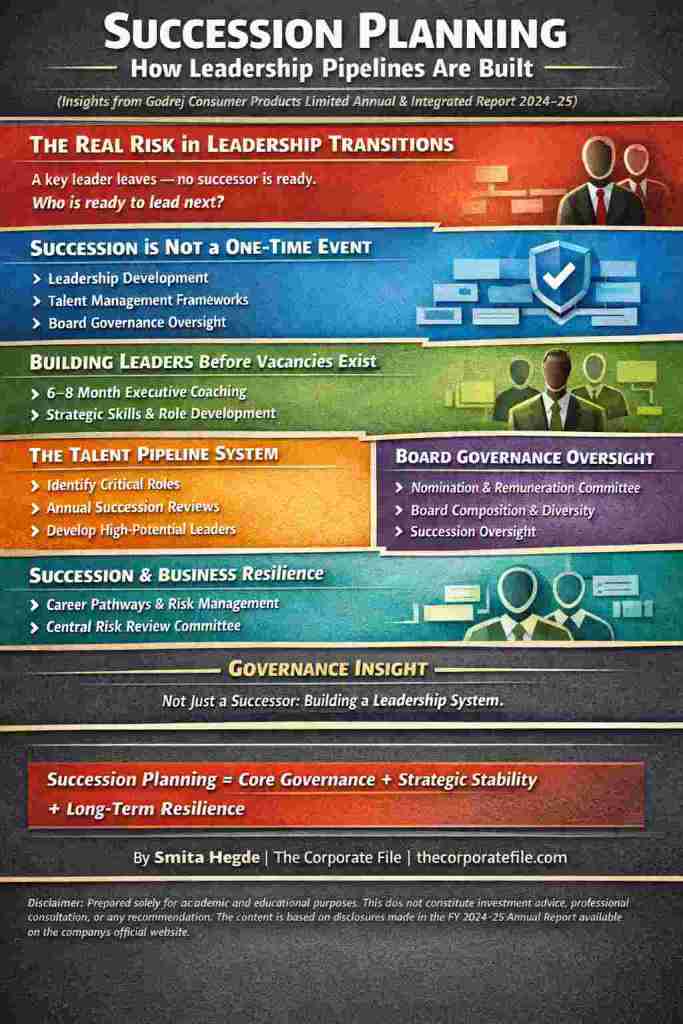
Rather than being treated as a one-time exercise, succession planning is embedded within:
- Leadership development systems
- Talent management frameworks
- Board-level governance processes
Together, these mechanisms transform succession planning into a continuous organisational capability.
Leadership Development as the Foundation
A credible succession pipeline does not emerge when a leadership vacancy appears.
It is built gradually through continuous leadership development.
According to the Godrej Consumer Products Limited Annual & Integrated Report 2024–25, executive coaching is one of the mechanisms used to strengthen leadership capabilities.
Senior leaders participate in structured 6–8 month executive coaching journeys designed to foster:
- Strategic reflection
- Personal leadership development
- Role-specific capability enhancement
These programmes involve members of the Godrej Leadership Forum (GLF) and individuals identified within succession pools.
Executive coaching enables leaders to:
- Reflect on complex strategic decisions
- Strengthen behavioural leadership capabilities
- Align personal leadership styles with organisational objectives
In many cases, leaders themselves recognise coaching as one of the most effective tools for achieving meaningful and long-lasting leadership development.
The Talent Management Framework
Succession planning at Godrej Consumer Products Limited (GCPL) operates within a broader talent management framework designed to build a sustainable leadership pipeline across the organisation.
The process involves several structured steps.
1. Identification of Critical Roles
The organisation identifies leadership positions that are strategically important for operational continuity and long-term growth.
2. Annual Succession Reviews
The company conducts periodic reviews of succession coverage for these critical roles, assessing whether internal successors are available and adequately prepared.
3. Identification of High-Potential Leaders
Employees who demonstrate leadership capability are identified and placed within leadership development pipelines.
4. Targeted Leadership Development
Development initiatives are then aligned to strengthen succession readiness and prepare future leaders for expanded responsibilities.
Through this structured framework, succession planning evolves from a reactive response to leadership vacancies into a proactive institutional system.
Governance Oversight: The Role of the Nomination and Remuneration Committee
Succession planning is not merely an operational or human-resources activity.
It is also a board governance responsibility.
At Godrej Consumer Products Limited, the Nomination and Remuneration Committee (NRC) plays a central role in ensuring that the board maintains the right balance of:
- Skills
- Experience
- Diversity
As disclosed in the Godrej Consumer Products Limited Annual & Integrated Report 2024–25, the committee periodically:
- Reviews board composition
- Oversees succession planning and talent development initiatives
- Evaluates candidates for board appointments in alignment with the company’s Board Diversity Policy
The committee also reports on governance policy implementation and regulatory compliance within the Corporate Governance section of the Annual Report.
Through such oversight mechanisms, succession planning becomes part of the institutional governance framework rather than remaining confined to management processes.
Leadership Continuity and Business Resilience
Leadership continuity is closely connected to organisational resilience.
The Godrej Consumer Products Limited Annual & Integrated Report 2024–25 indicates that the company’s Business Continuity Plan (BCP) incorporates elements such as:
- Long-term budgeting
- Employee career development
- Succession plans for key leadership positions
The objective of this framework is to ensure continuity in operations while minimising potential disruptions to:
- Stakeholders
- The environment
- Economic performance
To strengthen this system, the organisation conducts regular risk assessments and training programmes.
Major organisational risks are monitored and reviewed by a Central Risk Review Committee comprising members of the Board of Directors, reinforcing the integration between risk governance and leadership continuity.
Governance Insight: Succession as Institutional Design
The disclosures in the Godrej Consumer Products Limited Annual & Integrated Report 2024–25 highlight an important governance insight.
Succession planning is not simply about identifying the next individual who will occupy a leadership position.
Instead, it reflects how organisations design institutional continuity.
- Executive coaching strengthens leadership capability.
- Talent management systems identify and prepare future leaders.
- Board committees provide governance oversight and accountability.
Together, these mechanisms create a structured leadership ecosystem capable of sustaining organisational stability across leadership transitions.
For boards and governance professionals, the real test of succession planning is not whether a successor exists on paper.
The real test is whether the organisation has built a leadership system capable of producing multiple leaders ready to assume responsibility when required.
In that sense, succession planning is not merely an HR initiative.
It is a core governance function that safeguards long-term institutional resilience.
Disclaimer: Prepared solely for academic and educational purposes. This does not constitute investment advice, professional consultation, or any recommendation. The content is based on disclosures made in the FY 2024–25 Annual Report available on the company’s official website.
Connect on Linkedin www.linkedin.com/in/smita-hegde-90595b1b5


Leave a Reply