A boardroom story on why “showing up” is a governance obligation
Scene: Board Meeting Day
The Boardroom was ready.
Agenda circulated.
Notes reviewed.
Papers marked.
As required under Secretarial Standard-1,
every director had already received:
→ Notice of the meeting
→ Detailed agenda
→ Supporting papers
Yet—one chair remained empty.
Section: The Agenda is the Starting Point of Governance
Later, the Independent Director walked in.
Independent Director:
“I went through the agenda. It looked routine.”
CS (calm, firm):
“Once the agenda reaches you—
your responsibility has already begun.”
What SS-1 Actually Requires (Agenda Discipline)
Under Secretarial Standard-1:
- Notice must be sent in advance
- Agenda must be circulated with sufficient detail
- Notes and supporting documents must accompany it
CS (explaining):
“SS-1 ensures you are informed in advance—
so that you can participate meaningfully.”
Section: Minimum Meetings — As per Companies Act
CS:
“Let’s be clear on frequency.”
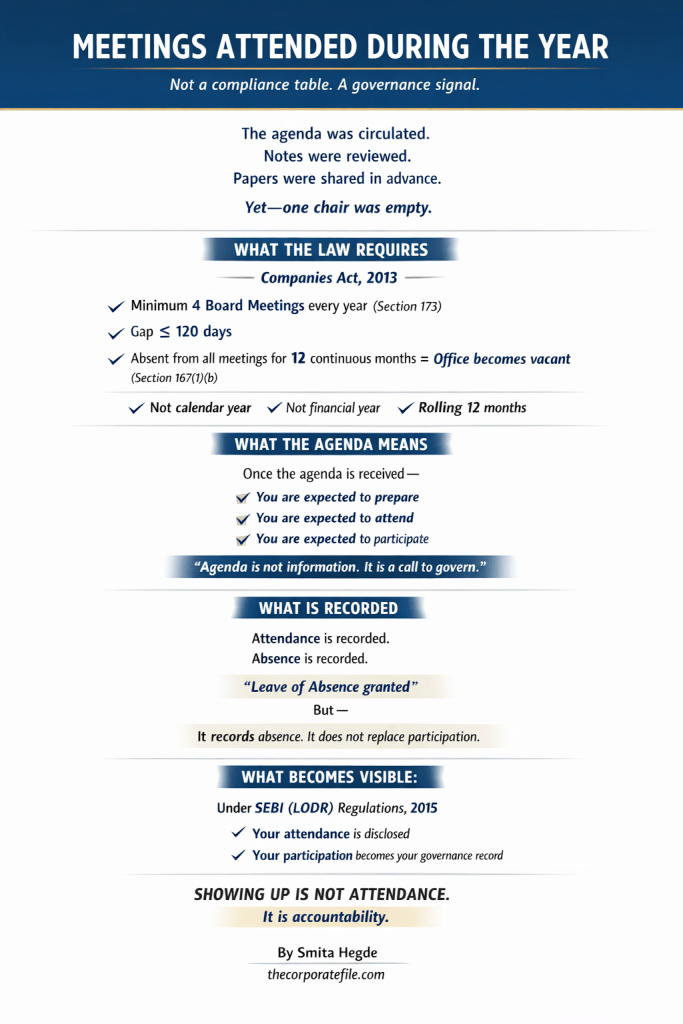
Under the Companies Act, 2013:
Section 173 — Board Meetings
- Minimum 4 Board meetings every year
- Maximum gap → 120 days between two meetings
“The law ensures governance is continuous—not occasional.”
Section: Attendance and Vacation of Office
CS:
“And now, the most critical provision.”
Section 167(1)(b) — Vacation of Office
If a director is absent from all Board meetings for a continuous period of 12 months,
the office of director shall become vacant.
CS (clarifying):
“This is:
→ Not calendar year
→ Not financial year
It is a rolling 12-month period.”
“The law removes you when absence becomes a pattern.”
Section: Recording of Absence (Correct Position)
Independent Director:
“But absence is recorded, right?”
CS:
“Yes.”
Under Secretarial Standard-1:
- Attendance of directors must be recorded
- Absence is also recorded in the minutes
CS (clarifying precisely):
“In practice, minutes may state:
→ ‘Leave of Absence was granted’”
(Pause)
“But understand this clearly—
this is a recording convention, not a substitute for attendance.”
Section: LODR — Public Visibility of Attendance
CS:
“And under the SEBI (LODR) Regulations, 2015:”
- Director-wise attendance is disclosed
- Board and Committee participation is made public
“Your attendance becomes part of your governance identity.”
The Turning Point
Independent Director:
“I had reviewed everything.”
The Core Governance Insight
CS:
“Reviewing prepares you.”
(Pause)
“Governance happens only in the meeting.”
Why Independent Directors Carry a Higher Responsibility
CS:
“You are not in management.”
“You are not inside daily operations.”
“So tell me—
Where does your role actually exist?”
Independent Director (quietly):
“In meetings.”
The Governance Hook
CS (firm, direct):
“Then every agenda you receive—
is a call to exercise your independence.”
“And every meeting you miss—
is a moment where that independence is absent.”
What Absence Actually Does
CS:
“When you are not present—
- Questions are not asked
- Decisions are not challenged
- Oversight is reduced
“And governance weakens—silently.”
Closing Moment
The Independent Director looked again at the agenda.
Not as paperwork.
But as responsibility.
Final Line
CS (calm, conclusive):
“The law enables you to govern.
The agenda prepares you to govern.
But only your presence allows you to govern.”
And for an Independent Director—
Showing up is not compliance.
It is the essence of the role.
Connect on Linkedin www.linkedin.com/in/smita-hegde-90595b1b5
 The Corporate File
Leave a comment