The Corporate File | Strategic Note
When the Honorable Prime Minister Narendra Modi compared today’s geopolitical environment to COVID-19, the signal was not about disruption.
It was about national preparedness and collective resilience.
In energy, that signal is unmistakable:
India cannot rely on markets alone.
It must actively manage, diversify, and future-proof its energy system.
🔶 The Reality: Oil Is Not a Free Market
Globally, prices are influenced by coordinated supply actions of
OPEC and OPEC+.
But in India, the deeper reality is internal:
• Retail fuel prices act as a fiscal lever
• Government intervenes during inflation cycles
• PSU margins are calibrated to prevent consumer shocks
👉 Oil operates as a part-market, part-policy-controlled system
📂 Case in Point: The Russian Crude Strategy
The Russia–Ukraine War disrupted global oil flows.
Market expectation: supply shock.
India’s response: system-level recalibration.
• Increased imports of discounted Russian crude
• Diversified sourcing beyond traditional suppliers
• Stabilized domestic cost structures
👉 This was not opportunistic buying.
It was system management under stress.
🔶 How the System Actually Runs
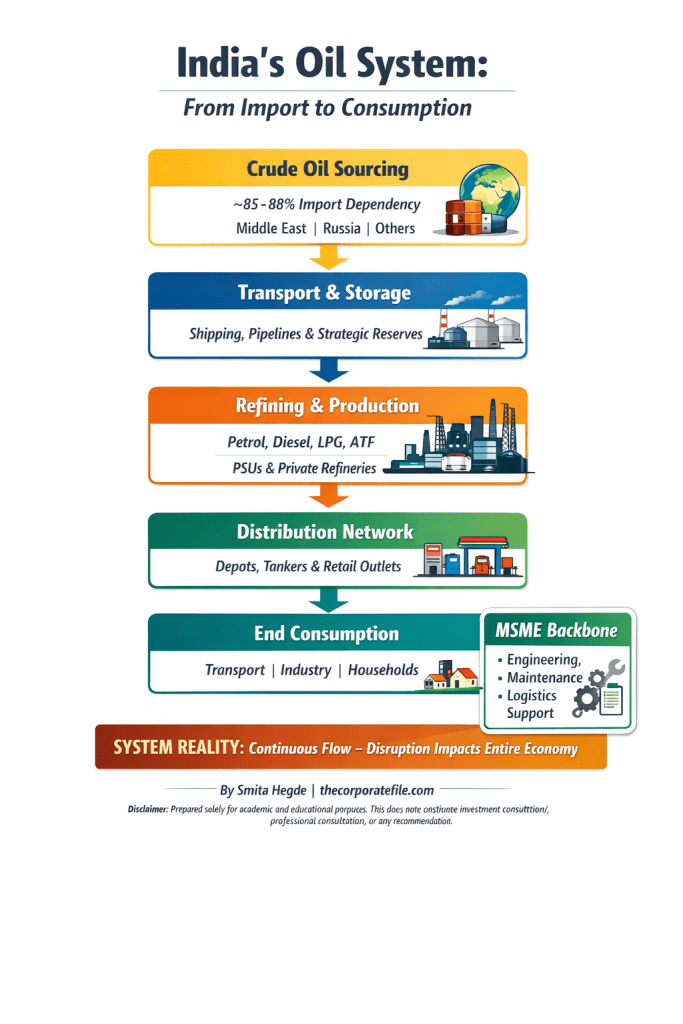
India’s oil system operates as a continuous, interdependent chain:
1. Import Layer (~85–88% dependency)
👉 https://ppac.gov.in/import-export
2. Refining Layer
• PSUs → stability
• Private → efficiency
3. Distribution Layer
• Nationwide logistics network
4. MSME Backbone
• Engineering, logistics, maintenance
👉 The system is integrated — not modular
🔶 Supply Chain Reality: Flow, Not Inventory
Oil is a flow system:
• Limited buffers
• Immediate disruption impact
🔶 PSU vs Private: A Designed Dual Structure
PSUs → Stability Layer
Private → Efficiency Layer
👉 Together, they ensure system resilience
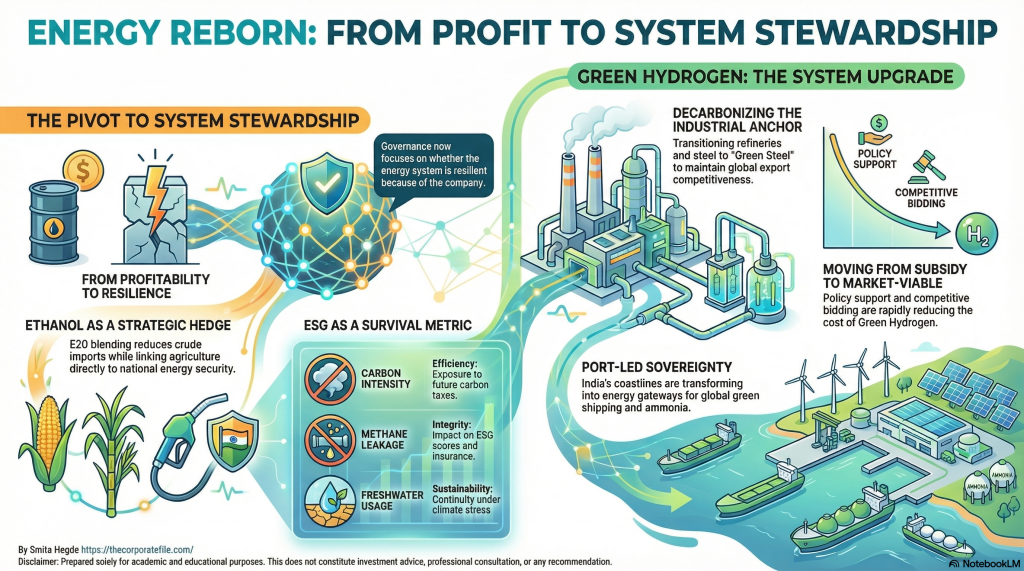
🔶 Governance Reframed: From Profit to System Stewardship
Oil companies are no longer just businesses.
They are system operators managing a national energy transition.
Boards now operate across three mandates:
• Commercial
• Policy
• Transition
Transition Mandate (Where Governance Is Redefined)
a) Ethanol: Reducing External Dependence
• E20 blending reduces crude imports
• Links agriculture to energy
• Acts as a currency hedge
b) ESG: From Narrative to Survival Metrics
| Environmental Factor | Focus Area | Why It Matters |
| Carbon Intensity | Efficiency | Exposure to future carbon taxes |
| Methane Leakage | Integrity | ESG score, compliance & insurance impact |
| Freshwater Usage | Sustainability | Operational continuity under climate stress |
👉 ESG is not reporting.
It is cost, risk, and continuity.
👉 The governance shift:
From
“Are we profitable?”
To
“Is the system resilient because of us?”
🔶 The Ultimate Hedge: Green Hydrogen (GH2)
If oil is a managed system, Green Hydrogen is the system upgrade.
It shifts India from an energy price-taker → price-maker.
1. The Industrial Anchor (Hard-to-Abate Sectors)
The focus has moved beyond pilots.
It is now about decarbonizing core industries:
• Refineries transitioning from grey to green hydrogen
• Steel sector adopting GH2 for “green steel” production
👉 This is not environmental positioning.
It is export competitiveness (CBAM readiness)
2. The Cost-of-Capital Revolution (SIGHT Program)
Under India’s Green Hydrogen mission:
• Large-scale production capacity has been awarded
• Costs are rapidly declining through competitive bidding
• Policy support (ISTS waivers) is reducing energy cost
👉 The shift:
Green Hydrogen is moving from subsidy-driven → market-viable
3. Port-Led Sovereignty: New Energy Corridors
India is building export-oriented green energy hubs:
• Western coast → Europe access
• Southern ports → green shipping
• Eastern hubs → fertilizer integration
👉 Coastlines are becoming future energy gateways
Closing Insight: Governance Has Already Shifted
Boards are no longer managing:
• Oil sourcing
• Refining margins
They are now managing:
👉 Electrolyzer → Hydrogen → Ammonia value chains
Green Hydrogen is not a future bet.
It is the next layer of energy sovereignty.
🔶 The New Metric: System + Transition Resilience
Energy companies must now be evaluated on:
• Supply continuity
• Import dependency reduction
• ESG readiness
• Transition execution capability
—not just financial performance
🔶 Closing Insight
India does not just consume energy.
It designs and manages an energy system.
Oil was the foundation.
Green Hydrogen is the upgrade.
🔷 The Corporate File — Signature Metric
A nation is not energy secure because it can buy energy.
It is secure because it can
control, transition, and sustain its energy system under disruption.
Disclaimer: Prepared solely for academic and educational purposes. This does not constitute investment advice, professional consultation, or any recommendation
Connect on Linkedin www.linkedin.com/in/smita-hegde-90595b1b5
 The Corporate File
Leave a comment