🔶 The Opening Signal: Preparedness, Not Disruption
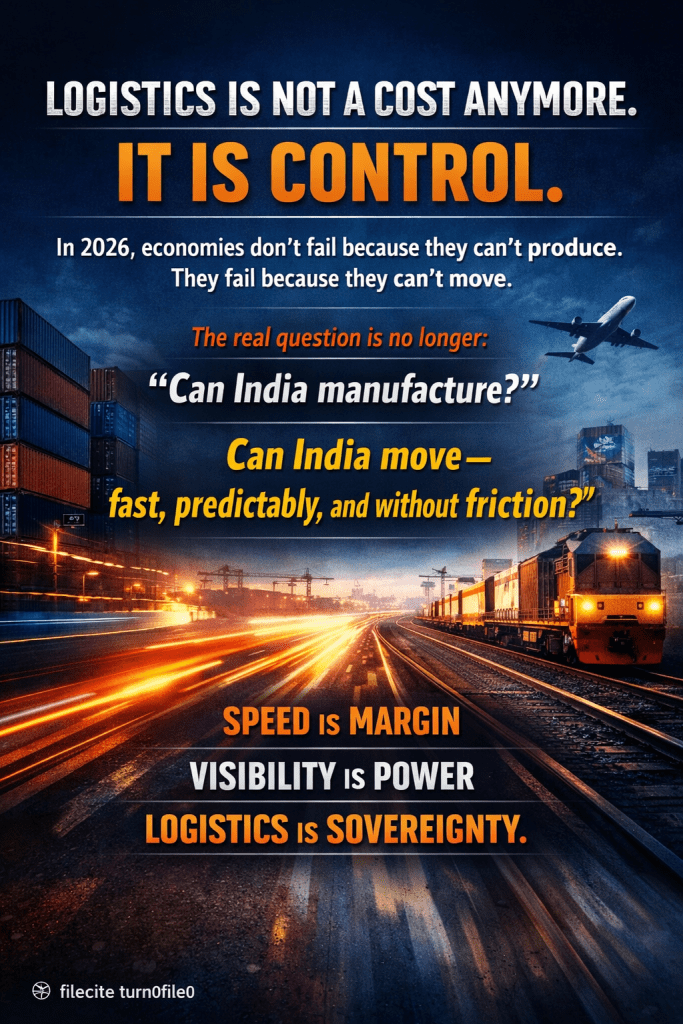
When the Honourable Prime Minister Narendra Modi compared today’s geopolitical environment to COVID-19, the signal was not about disruption.
It was about preparedness at a system level.
That distinction is critical.
Because in 2026, disruption is no longer episodic.
It is structural.
The question is no longer whether shocks will occur.
It is whether systems are designed to absorb them without breaking.
At the center of that system lies one underestimated lever:
Logistics.
🔶 The Paradigm Shift: From Cost Center to Sovereign Control
In Indian boardrooms, logistics is still viewed as a cost center.
That assumption is now obsolete.
Logistics is no longer a utility.
It is Sovereign Economic Control.
If you do not control the flow,
you do not control the economy.
India is not just building infrastructure.
It is engineering economic velocity.
🔶 1. The Real Question: Can We Move?
For decades, the debate was framed as:
Should India import or not?
That is now the wrong question.
In a fragmented geopolitical economy, logistics determines:
• Whether imports remain cost advantages or become inflation triggers
• Whether exports scale or stall at the gate
• Whether supply chains absorb shocks or amplify them
👉 The shift is decisive:
It is no longer about the cost of goods.
It is about whether India can move those goods efficiently, predictably, and without economic leakage.
🔶 2. The Death of the “14% Cost Myth”
India’s logistics cost was long cited at 13–14% of GDP.
That narrative is now being dismantled.
The system is moving toward:
👉 ~7–8% efficiency benchmark
But the real transformation is not numerical.
It is structural:
• From Cost → Time + Reliability
Speed is now a margin lever
• From Modal Silos → Integrated Flow Systems
Road, Rail, and Coastal logistics are converging
• The ULIP Layer
The Unified Logistics Interface Platform (ULIP) is not just digital infrastructure
👉 It is the nervous system of Indian trade, eliminating visibility gaps that lock working capital
We are witnessing the end of fragmented logistics
and the rise of flow architecture
🔶 3. Integration: Control the Chain or Lose It
The defining shift in 2026 is clear:
End-to-End Integration
When Adani Ports and Special Economic Zone Limited integrates ports, rail, warehousing, and logistics—
this is not expansion.
👉 This is value chain control
Fragmentation results in:
• Delays
• Cost leakage
• Working capital lock-up
Integration delivers:
• Speed
• Predictability
• Margin expansion
👉 In 2026, third-party dependence is no longer efficiency
It is embedded systemic risk
🔶 4. The Human Element: Logistics as Social Infrastructure
This is the most ignored—and most critical—layer.
A fully automated port is irrelevant
if last-mile logistics collapses.
The system runs on:
• Truck drivers
• Port labour
• Warehouse workforce
The real risk is not technological failure.
It is:
• Fatigue
• Safety lapses
• Informal labour structures
👉 The governance shift is clear:
• Safety = continuity
• Welfare = stability
• Workforce governance = risk control
Human-centric logistics is not CSR.
👉 It is the foundation of 24/7 economic continuity
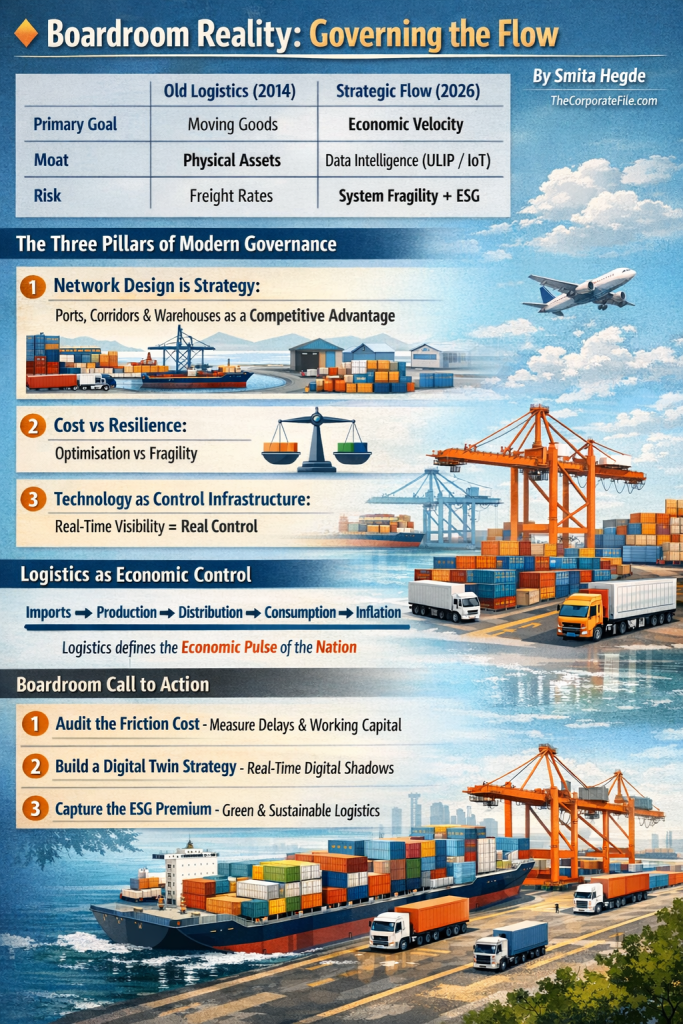
🔶 5. Boardroom Reality: Governing the Flow
The role of the board has fundamentally changed.
From managing assets → to governing flow systems
| Feature | Old Logistics (2014) | Strategic Flow (2026) |
| Primary Goal | Moving Goods | Economic Velocity |
| Moat | Physical Assets | Data Intelligence (ULIP / IoT) |
| Risk | Freight Rates | System Fragility + ESG |
🔹 The Three Pillars of Modern Governance
1. Network Design is Strategy
Ports, corridors, and warehouse placement define competitive advantage
2. Cost vs Resilience
Over-optimisation creates fragile systems
Resilience is now a strategic variable
3. Technology as Control Infrastructure
If you cannot see the system in real time,
you cannot govern it
🔶 Closing Insight: Logistics as Economic Control
Logistics is not a sector.
It is a system that connects:
Imports → Production → Distribution → Consumption → Inflation
Ports control entry.
Logistics controls movement.
Together, they define the economic pulse of the nation
🔶 Boardroom Call to Action
1. Audit the Friction Cost
Move beyond freight bills
Measure working capital locked in delays
2. Build a Digital Twin Strategy
Every physical movement must have a digital shadow
👉 If it is not visible in real time, it is not governed
3. Capture the ESG Premium
Green logistics is no longer optional
👉 It is the gateway to global supply chain integration
🔷 The Corporate File — Signature Metric
An economy is not competitive because it produces more.
It is competitive because it can
move, deliver, and scale that production with speed, precision, and resilience.
Disclaimer: Prepared solely for academic and educational purposes. This does not constitute investment advice, professional consultation, or any recommendation
Connect on Linkedin www.linkedin.com/in/smita-hegde-90595b1b5
 The Corporate File
Leave a comment