In 2026, a Nifty 50 contract isn’t won in the boardroom—it’s won in the audit trail.
While most MSMEs are chasing “vendor” status, a select few are becoming compliance-critical partners.
They are not selling recycling services.
They are solving regulatory risk.
This is the invisible playbook they are using.
🧠 The Shift No One Is Talking About
India’s plastics circularity ecosystem is no longer driven by sustainability intent.
It is driven by:
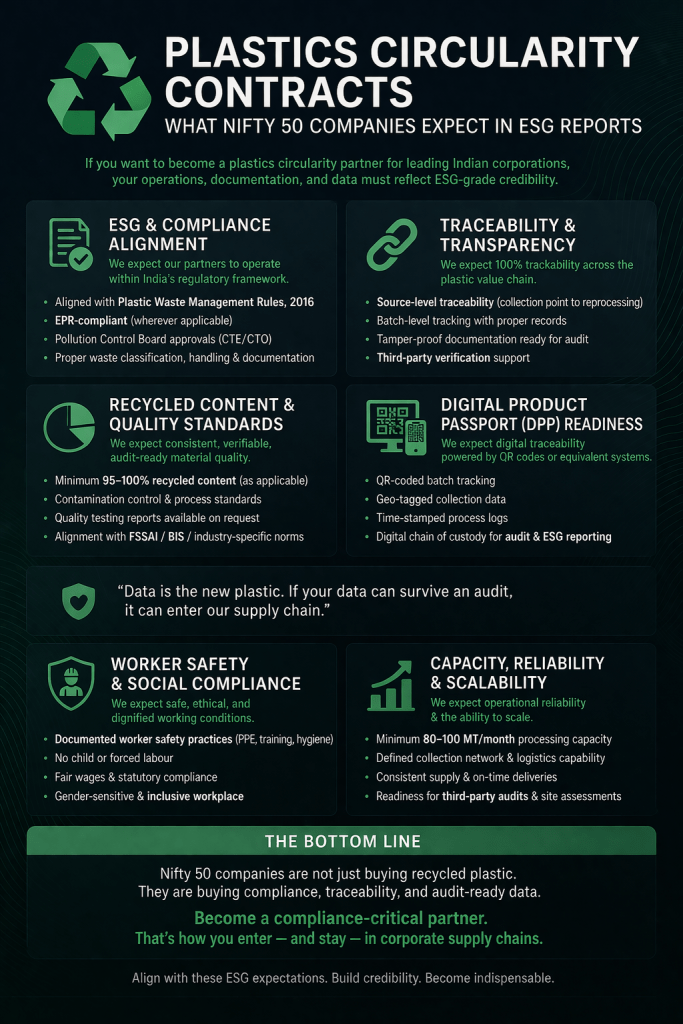
- Plastic Waste Management Rules, 2016
- Extended Producer Responsibility (EPR) Guidelines
- SEBI BRSR Core Framework
And with BRSR Core assurance tightening toward 2026, the pressure is real.
👉 Which means:
Companies are no longer asking:
“Who can recycle plastic?”
They are asking:
“Who can pass an audit—consistently, at scale?”
⚡ The Contrarian Insight (The 1% Advantage)
The average advice:
Focus on better recycling technology
The 1% playbook:
Ignore the technology—for a moment. Focus on the Governance Gap
Large corporates are not afraid of plastic waste.
👉 They are afraid of:
- Audit failures
- EPR non-compliance
- ESG data inconsistencies
If your MSME can:
- Provide 100% traceable documentation
- Generate audit-ready data
- Maintain compliance integrity across scale
👉 You solve Audit Anxiety
And that is where the real value lies.
📊 The Trust Premium: Why Data Is the New Plastic
A ton of recycled plastic has a market price.
But a ton of recycled plastic with:
- Verified origin
- Digital traceability
- Audit-ready certification
👉 Commands a premium.
Because:
👉 You are no longer selling material
👉 You are selling certainty
Insight:
Data is the new plastic.
Traceability is the new margin.
🔗 The Rise of Digital Product Passports (DPP)
The future of plastics circularity is moving toward Digital Product Passports (DPP).
👉 What this means for MSMEs:
You don’t need complex tech to start.
Even basic systems can create massive differentiation:
- QR code tagging for plastic batches
- Geo-tagged collection points
- Time-stamped processing logs
- Digital material tracking sheets
👉 This enables:
- Real-time material accounting
- Verifiable chain of custody
- Audit-ready ESG reporting
This is your competitive edge.
Not machinery.
Not scale.
👉 Traceability infrastructure
🧱 Your Real Role in the Value Chain
You are not:
- A recycler
- A waste collector
- A vendor
👉 You are:
The last-mile compliance infrastructure of corporate India
You are helping companies comply with:
- Plastic Waste Management Rules, 2016
- Extended Producer Responsibility (EPR) Guidelines
- SEBI BRSR Core Framework
📊 The Cheat Sheet (Screenshot This)
| The Average MSME Vendor | The Top 1% Circularity Partner |
| Focus: Price per KG | Focus: Cost of Compliance Avoidance |
| Evidence: Weight slips | Evidence: Geo-tagged, audit-ready chain of custody |
| Model: Collection-driven | Model: Data + compliance-driven |
| Relationship: Transactional | Relationship: Integrated into ESG systems |
| Value: Replaceable | Value: System-critical |
| Future: Margin pressure | Future: Trust premium |
🚪 The Real Buyer (Newsjacking Insight)
With 2026 BRSR Core assurance tightening, accountability has shifted.
If you approach a large company today:
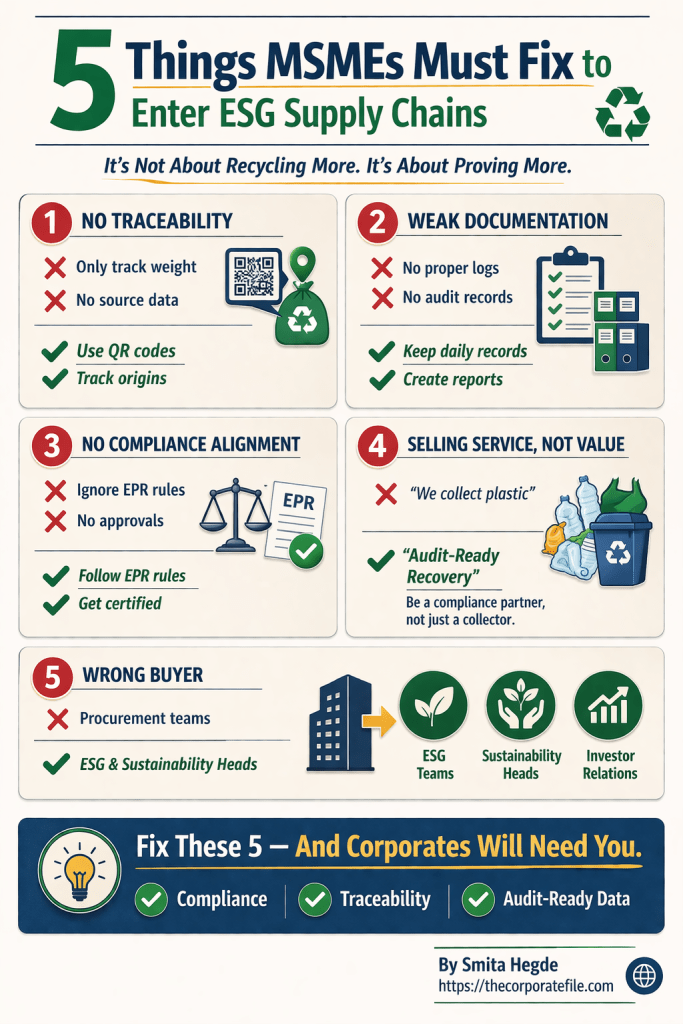
❌ Don’t ask Procurement
✅ Ask:
- Chief Sustainability Officer (CSO)
- ESG Head
- Investor Relations
👉 Because:
They are the ones:
- Answerable to regulators
- Accountable for ESG disclosures
- Under pressure from audits
👉 They are your real buyers
🔗 The Real Onboarding Path (What Actually Works)
You don’t enter directly.
You enter through:
- EPR service providers
- Producer Responsibility Organisations (PROs)
- Circular economy platforms
Then:
- Submit compliance + capability documents
- Prove operational data
- Execute pilot
- Pass audit
- Scale
👉 This is not onboarding
👉 This is compliance validation
🚧 Where Most MSMEs Fail
- They sell services, not compliance
- They show activity, not audit readiness
- They ignore documentation
- They lack traceability systems
👉 Result: They remain replaceable
💡 The Final Positioning Shift
Old mindset:
“We recycle plastic”
New mindset:
“We provide EPR-compliant, audit-ready, traceable plastic recovery systems”
🎯 Final Insight
Large companies are not trying to reduce plastic.
👉 They are trying to de-risk regulatory exposure in a post-BRSR world
And they are quietly asking:
“Who can carry this burden for us—reliably, transparently, and at scale?”
📌 One-Line Takeaway
In 2026, the winner is not the MSME with the best recycling technology.
👉 It is the one whose data can survive an audit.
Disclaimer: This content is fictional and intended solely for creative expression. Any resemblance to real companies, organizations, or individuals is purely coincidental and unintended. The creator disclaims any liability arising from such resemblance. Prepared solely for academic and educational purposes. This does not constitute investment advice, professional consultation, or any recommendation
Connect on Linkedin www.linkedin.com/in/smita-hegde-90595b1b5
 The Corporate File
Leave a comment