The Nomination & Remuneration Committee (NRC) meeting had just begun.
Two profiles were on the table.
- Candidate A → Currently a Partner in an entity engaged in a similar line of business
- Candidate B → Senior professional, with no connection to any competing or similar business
A pause filled the room.
This wasn’t a hiring decision.
This was a governance decision.
🎙️ Chairperson:
“Let’s address the real question —
Are we comfortable appointing someone already engaged in a similar business?”
🎙️ Independent Director:
“This is not about capability.
This is about conflict of interest and fiduciary alignment.”
🎙️ Committee Member:
“But there is no explicit prohibition, right?”
⚖️ The Company Secretary Speaks ;
🎙️ Company Secretary:
“Correct. There is no absolute prohibition under law.
However, the framework we must consider is clear:
- Section 166, Companies Act, 2013 → Duty to avoid conflict of interest
- Section 184, Companies Act, 2013 → Disclosure of interest in other entities
- SEBI (LODR) Regulations, 2015
→ Regulation 4(2)(f): Governance principles
→ Regulation 17(1)(c): Independent judgment of the Board - Secretarial Standards (SS-1 & SS-2) → Proper disclosure and recording
Now, beyond law —
As per SES Proxy Advisory Guidelines (FY 2025–26), Page 28, Point 1,
engagement in a similar line of business is a governance-sensitive issue,
requiring case-by-case evaluation from a conflict and shareholder interest perspective.
And practically — this is where the real risk lies:
If Candidate A participates in Board discussions,
there is a real possibility of exposure to
Unpublished Price Sensitive Information (UPSI).
This is not just a compliance issue under insider trading norms —
it is a strategic leakage risk that Boards cannot afford.”
(The room shifts. This is no longer theoretical.)
🔍 Reframing the Question
🎙️ Chairperson:
“So this is not about whether it is allowed…
but whether it is safe for the company.”
🎙️ Company Secretary:
“Exactly.
Disclosure ensures transparency.
But governance demands judgment under uncertainty.
A Partner in a similar business doesn’t just create conflict —
it creates continuous exposure risk.”
🧾 Role of the Company Secretary (Where Governance is Built)
(The room turns toward the CS.)
🎙️ Company Secretary:
“I would recommend evaluating:
- Degree of business overlap
- Access to strategic and price-sensitive information
- Effectiveness of recusal mechanisms
- Impact on shareholder perception and trust”
🎙️ Chairperson:
“This is very well articulated.
You’re not just guiding us on compliance —
you’re helping us understand governance consequences.”
🎙️ Independent Director:
“Agreed.
This is what elevates the role of the Company Secretary —
from compliance officer to governance architect.”
⚖️ Director’s Dilemma: A Practical Checklist for NRC
Before approving a “similar business” candidate, ask:
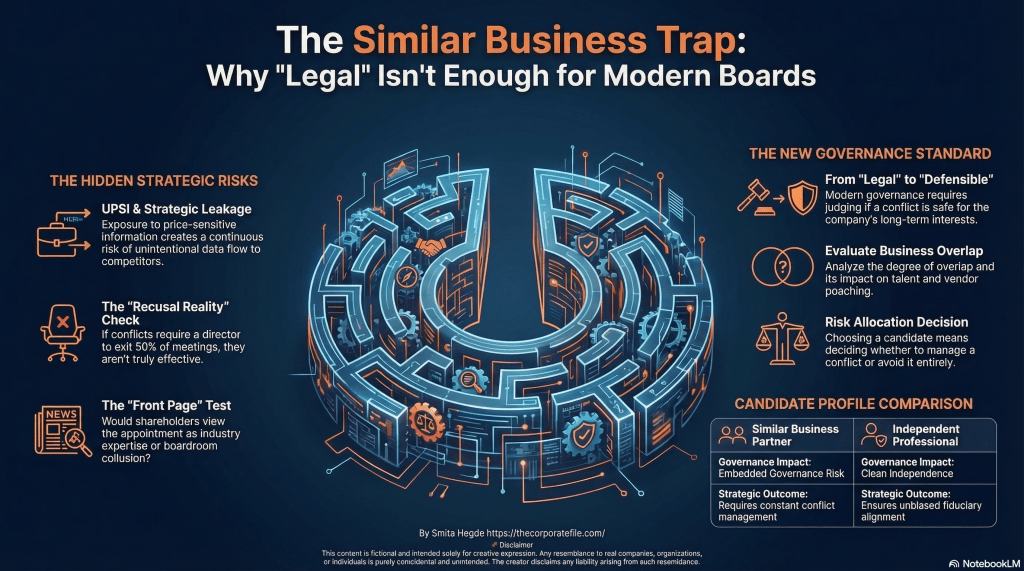
- Information Asymmetry → Will this person sit on the Board of a competitor tomorrow?
- UPSI Risk → Can strategic discussions unintentionally flow into another business?
- Poaching Risk → Does their partnership expose access to our talent or vendors?
- The “Front Page” Test → If reported in Business Newspapers does it read as expertise or collusion?
- Recusal Reality → If the director must exit 40–50% of meetings, are they truly effective?
⚖️ Final Deliberation
🎙️ Chairperson:
“Let’s be clear:
- Candidate A brings expertise, but also embedded governance risk
- Candidate B brings clean independence
So this is not a hiring decision.
It is a risk allocation decision.”
(Looks around the table)
“Do we want to manage conflict…
or avoid it?”
🔥 Governance Insight: Where Modern Boards Must Evolve
Frameworks like SES Proxy Advisory Guidelines make one thing clear:
“Similar business” is not a disclosure issue.
It is a fiduciary judgment call with long-term consequences.
The real shift is this:
From asking — Is this allowed?
To asking — Is this defensible?
💡 Final Thought
In governance, the most dangerous decisions are not illegal.
They are perfectly legal — and strategically damaging.
🚀 Call to Action
Is your Board evaluating candidates based on yesterday’s compliance
or tomorrow’s governance risks?
Let’s discuss in the comments.
Disclaimer: This content is fictional and intended solely for creative expression. Any resemblance to real companies, organizations, or individuals is purely coincidental and unintended. The creator disclaims any liability arising from such resemblance.
Connect on Linkedin www.linkedin.com/in/smita-hegde-90595b1b5
 The Corporate File
Leave a comment