“I’m ready.”
Arjun said it with confidence.
It was also the most expensive sentence he had ever uttered.
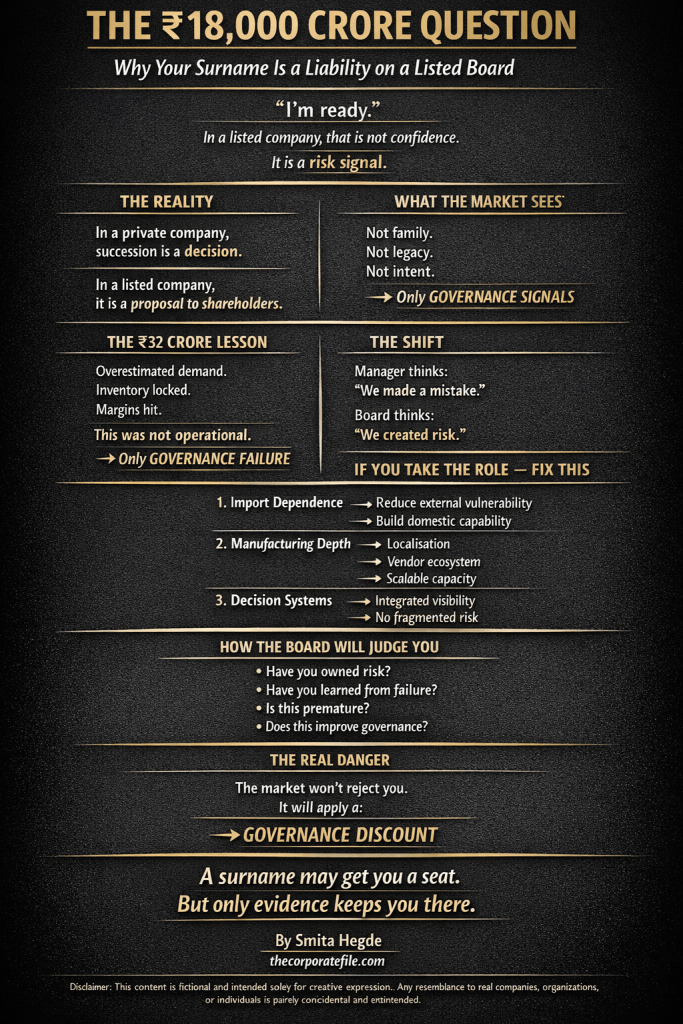
In a ₹18,000 crore listed manufacturing company, “ready” is not a feeling.
It is a risk assessment.
His grandfather did not look up.
“The shareholders don’t care if you’re ready, Arjun,” he said calmly.
“They care if you are a risk.”
The Misunderstanding
Rao Industries Limited operates in industrial components and automotive supply chains.
Three generations are connected to the company.
But the market does not recognise generations.
It recognises governance signals.
“In a private company,” Mr. Rao continued,
“succession is a decision.”
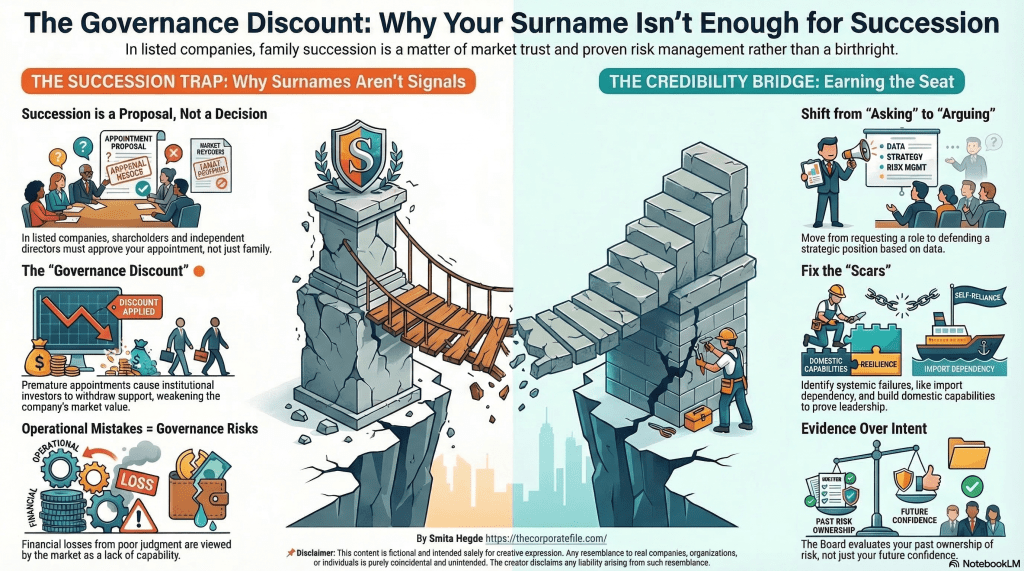
“In a listed company, it is a proposal to thousands of shareholders.”
Under the Companies Act, 2013 and the SEBI (LODR) Regulations, 2015:
- Your appointment requires shareholder approval
- The Nomination & Remuneration Committee evaluates you
- Independent Directors must apply objective judgment
“You are not asking me for a position,” he said.
“You are asking the market for trust.”
The Scar — What You Haven’t Understood Yet
Mr. Rao finally closed the file and looked at him.
“Do you remember last year’s procurement decision?”
Arjun’s expression changed.
They had overestimated demand.
Imported components were locked in inventory.
Working capital tightened.
Margins were hit.
“It was a ₹32 crore lesson,” Mr. Rao said.
He let that sink in.
“You treated it as an operational mistake.”
“It was not.”
“Operational mistakes become financial risks.
Financial risks become governance concerns.”
“That,” he said,
“is the difference between a manager and an Executive Director.”
The Turning Point — From Asking to Arguing
Arjun did not speak immediately this time.
When he did, the tone had changed.
“You’re right,” he said.
“We didn’t just misjudge demand.”
“We exposed the company to import dependency risk.”
Now he was not asking for a role.
He was defending a position.
The Proposal — Not a Plan, But a Position
“If I take responsibility,” Arjun continued,
“this is what I will change.”
First — Import Dependence
“We are over-reliant on external sourcing for critical components.”
“That ₹32 crore loss was not just a forecasting issue.”
“It was a supply chain design failure.”
“I will identify top dependency areas and build domestic vendor capabilities.”
“Not for cost alone—but for risk control.”
Second — Manufacturing Depth in India
“Our production model is not built for scale.”
“We expand volume, but not capability.”
“I want to strengthen manufacturing within India—”
- Increase localization
- Build deeper vendor ecosystems
- Expand capacity where demand visibility exists
“So that growth does not increase vulnerability.”
Third — System-Led Decision Making
“That mistake happened because decisions were fragmented.”
“I want full visibility across procurement, logistics, and demand planning.”
“So that no single decision locks capital without oversight.”
He paused.
“And I want full accountability for this.”
The Silence That Matters
For the first time, Mr. Rao did not interrupt.
Because this was no longer a request.
It was a case being made.
The Board’s Lens — What Will Actually Be Evaluated
“Good,” Mr. Rao said.
“But understand how this will be judged.”
“This will not be evaluated by me.”
“It will go to the Board.”
“It will be reviewed by the Nomination & Remuneration Committee.”
“It will be seen by Independent Directors.”
“And finally—”
“It will go to shareholders.”
Their questions will be simple:
- Has he owned risk before?
- Has he learned from failure?
- Is this succession structured or premature?
- Does this strengthen governance credibility?
“They are not evaluating your intent.”
“They are evaluating your evidence.”
The Real Risk — If You Get This Wrong
“If this appointment is seen as premature,” Mr. Rao continued,
“It will not fail loudly.”
“It will pass.”
“But—”
- Institutional investors will show lower support
- Confidence will weaken
- Future decisions will face higher scrutiny
“The market does not reject you directly.”
“It applies a governance discount.”
The Bridge — What Actually Creates Trust
“Succession is not about timing,” Mr. Rao said.
“It is about readiness demonstrated over time.”
“This is how it works:”
- You take ownership
- You make decisions with consequences
- You are evaluated independently
- You earn Board visibility
- Then you are considered
“Law is not a hurdle.”
“It is the bridge between control and credibility.”
The Closing
Mr. Rao stood up.
“Do this,” he said.
“Fix what you broke.”
“Reduce import dependence.”
“Build manufacturing strength in India.”
“Create systems that prevent that mistake from happening again.”
“And then—”
“You won’t need to say ‘I’m ready.’”
Final Insight
In promoter-led listed companies, succession does not fail because of family involvement.
It fails because credibility is assumed, not demonstrated.
A surname may get you a seat at the table.
But only evidence keeps you there.
Disclaimer: This content is fictional and intended solely for creative expression. Any resemblance to real companies, organizations, or individuals is purely coincidental and unintended. The creator disclaims any liability arising from such resemblance.
Connect on Linkedin www.linkedin.com/in/smita-hegde-90595b1b5
 The Corporate File
Leave a comment