The agenda item looks routine:
“Approval of Executive Director Remuneration”
A 50-year legacy company.
High debt. Cyclical profits. Capital-intensive operations.
Then comes the proposal:
• 35% increase in executive director pay
• Commission linked to “long-term project pipeline”
• Justification: industry benchmarking
—
🟢 In the Boardroom
The promoter-family Chair opens:
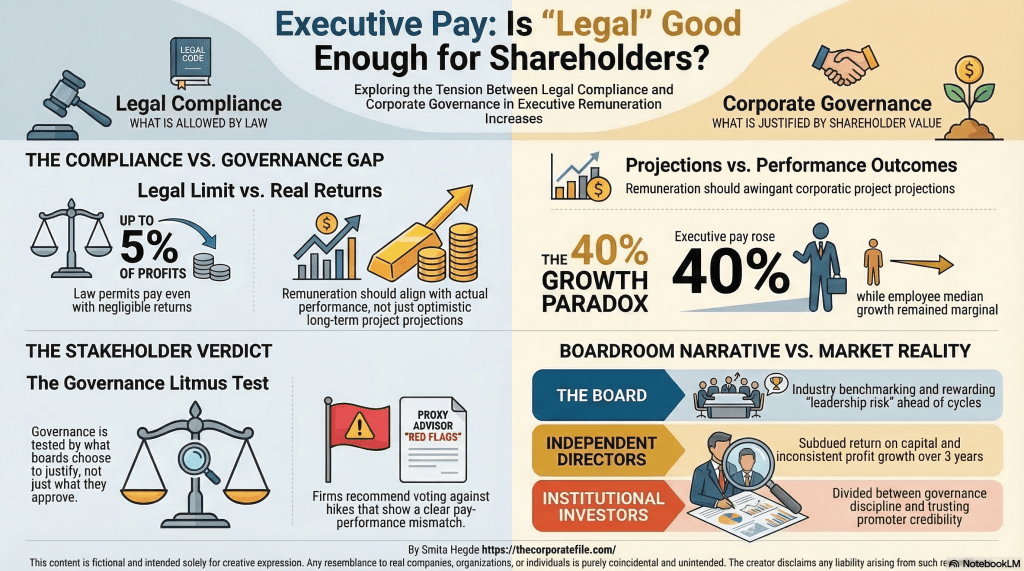
“Section 197 of the Companies Act, 2013 permits up to 5% of net profits. We are at 3%. Fully compliant.”
Silence.
An Independent Director responds:
“Over the last 3 years—
profit growth is inconsistent
return on capital remains subdued
shareholder returns are negligible
but remuneration has increased 40%.”
Chair responds:
“Infrastructure is not linear. Returns are back-ended.
We must reward leadership ahead of the cycle.”
—
🔴 The Real Conversation
Independent Director (calmly):
“We are approving compensation today based on projections.
But the outcomes are uncertain.”
“If execution delays happen—as they often do in this sector—
shareholders will wait, but remuneration would already be paid.”
Chair responds:
“Execution risk is inherent in infrastructure.
Leadership is being compensated for taking that risk, not just outcomes.”
The room settles.
Not because the concern is resolved—
but because it is acknowledged.
—
⚠️ On Median Pay Gap
Independent Director:
“Leadership pay is up 40%, while employee median growth is marginal.”
Chair responds:
“Leadership accountability and strategic responsibility operate at a different scale.”
—
⚖️ The Decision
The resolution passes.
Section 197 → complied
Schedule V → within limits
LODR → disclosures made
Independent Directors record concern.
Because:
Promoter Rights are legal.
But Public Capital demands balance.
—
📉 Then Comes the Shareholders
Proxy Advisory Firms:
→ Flag pay-performance mismatch
→ Recommend Vote Against
Institutional Investors:
→ Mixed response
Why mixed?
• Some prioritise governance discipline → oppose
• Others factor promoter credibility & long-term bets → support/abstain
👉 It becomes a judgment call, not a rule-based decision
—
📰 Media Interpretation
View 1:
→ “High Pay Amid Weak Returns”
👉 Signals misalignment → raises governance concerns
View 2:
→ “Company Bets on Leadership for Long-Term Growth”
👉 Frames it as strategic continuity → supports management narrative
—
🔥 Final Outcome
• Promoter shareholding ensures approval
• Resolution passes
Because:
The law permits it.
And control secures it.
—
🧠 Interpreting the Governance Signal
This is where compliance meets judgment.
Promoters bring:
• Capital
• Strategy
• Long-term vision
But markets evaluate something deeper:
• Trust in capital allocation
• Reliability of execution
• Consistency in shareholder outcomes
Because governance is not about what boards can approve—
but what they choose to justify.
Because governance is not tested in approvals—
it is tested over time.
📈 When strategy translates into results → trust compounds
📉 When it doesn’t → questions remain, even if decisions were compliant
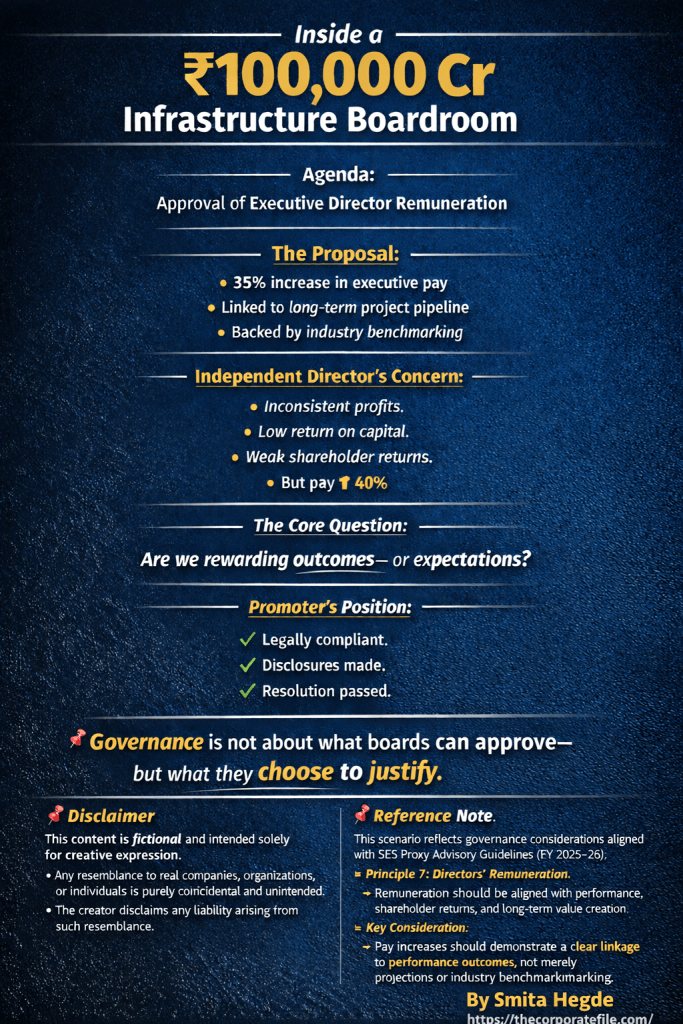
📌 Disclaimer : This content is fictional and intended solely for creative expression.
Any resemblance to real companies, organizations, or individuals is purely coincidental and unintended.
The creator disclaims any liability arising from such resemblance.
📌 Reference Note : This scenario reflects governance considerations aligned with SES Proxy Advisory Guidelines (FY 2025–26): Principle 7: Directors’ Remuneration
→ Remuneration should be aligned with performance, shareholder returns, and long-term value creation. Link; https://www.sesgovernance.com/assets/pdfs/proxy-advisory/1750172548_Proxy-Advisory-Guidelines_FY-2025-26_Website.pdf
Connect on Linkedin www.linkedin.com/in/smita-hegde-90595b1b5
 The Corporate File
Leave a comment