The Guardians of Trust
“Sit down for a minute,” the old man said, folding the newspaper and looking at the young boy.
“You keep using your phone to send money, invest, do everything… but have you ever thought about this?”
The boy looked up.
“In banking, trust is the most valuable currency.”
He paused.
“People trust banks with their savings. Investors trust them with their money. Even regulators trust them to keep the system stable.”
Then he leaned forward slightly.
“And at the center of all this… sits a group of people called the board of directors.”
“They guide strategy, oversee risk, and protect everyone’s interests.”
The boy nodded slowly.
“But tell me,” the old man asked, “how does a bank make sure the right people sit on that board?”
Without waiting, he continued—
“There is a proper system for it. A detailed policy… not just a guideline, but a full structure.”
“A framework designed to ensure that only people with the right knowledge and the right character get that responsibility.”
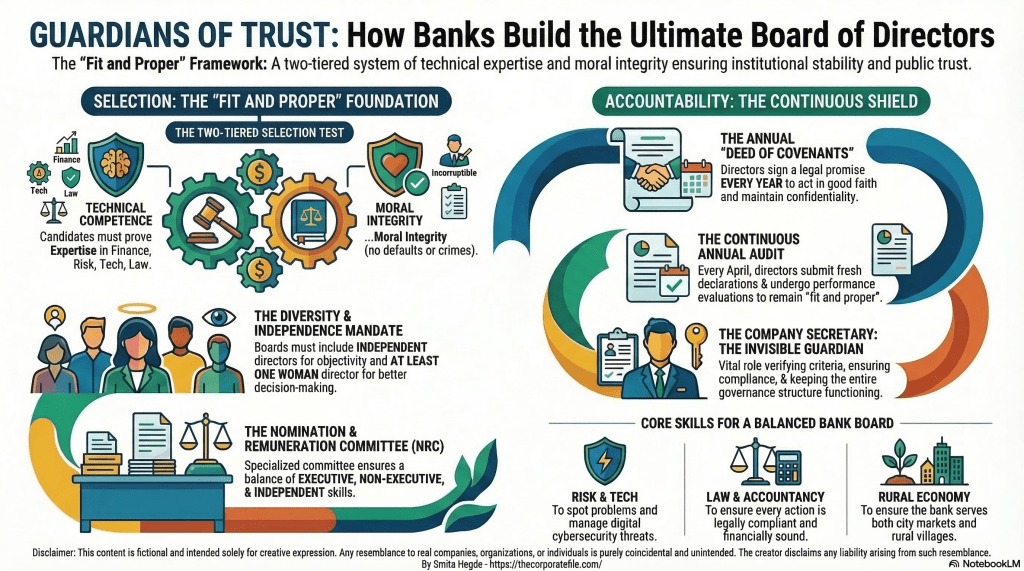
1. Defining “Fit and Proper”: The Two-Tiered Test
“Now listen carefully,” the old man said.
“Being a director is not about seniority or reputation alone.”
“A person must pass two tests.”
He raised two fingers.
“First—Technical Competence.
Second—Moral Integrity.”
“Only when both are satisfied, the person is considered ‘fit and proper’.”
A. Technical Competence: Beyond General Management
“You see,” he explained, “a bank cannot run on general knowledge.”
“The people on the board must bring specific expertise.”
He counted slowly:
- “Banking and Finance—understanding money, liquidity, assets.”
- “Risk Management—seeing problems before they happen.”
- “Technology and Cybersecurity—because today everything is digital.”
- “Law and Accountancy—so every action is legally correct.”
- “Agriculture and Rural Economy—because banks also serve villages, not just cities.”
He looked at the boy.
“This is how a balanced board is created.”
B. Moral Integrity: The “Clean Slate” Requirement
Then his voice became serious.
“But knowledge alone is not enough.”
“In banking… integrity is everything.”
“The system checks a person’s character very carefully.”
He continued:
- “Have they ever defaulted on loans?”
- “Any criminal cases involving serious wrongdoing?”
- “Any action taken by regulators against them?”
He paused.
“Even one serious doubt… and the person may not be considered.”
2. The Diversity Mandate: Not Just a Buzzword
The boy asked, “Is that all?”
The old man smiled.
“No. Even after selecting people, the board must be properly designed.”
“Because if everyone thinks the same way, they will miss the same risks.”
Gender Representation
“There must be at least one independent woman director.”
“This ensures representation… and improves the quality of decisions.”
Independent Directors
“Some directors must be completely independent.”
“They are not influenced by management.”
“They bring objectivity.”
He added:
- “They oversee management decisions.”
- “They protect minority shareholders.”
- “They ensure transparency.”
Diversity of Skills
“There is also a committee—called the Nomination and Remuneration Committee.”
“They keep checking whether the board has the right balance.”
- “Executive directors”
- “Non-executive directors”
- “Independent directors”
“And most importantly… whether the board as a whole has the skills needed for changing times.”
3. The “Deed of Covenants”: Accountability in Writing
Now the old man leaned closer.
“This is one of the most important parts… but many people don’t notice it.”
“When a director is appointed, they sign a document.”
“A legal agreement.”
“Not just formality… but a set of promises.”
He explained slowly:
- “They must act in good faith.”
- “They cannot misuse their position.”
- “They must keep information confidential.”
- “They must speak independently—without fear or favour.”
“And remember,” he said,
“They don’t sign it once. They confirm it every year.”
4. The Continuous Audit: Why the Job is Never ‘Done’
The boy looked surprised.
“Every year?”
“Yes,” the old man said.
“In this system, being ‘fit and proper’ is not permanent.”
“It must be proved again and again.”
He explained:
- “Every April, directors submit fresh declarations.”
- “Their performance is evaluated—especially for re-appointment.”
- “They are trained regularly on new risks and regulations.”
“This keeps them updated… and accountable.”
Why This Matters to Stakeholders
The old man leaned back.
“You may not see all this happening.”
“But it matters.”
“These systems ensure that governance is not just one-time compliance.”
He continued:
- “It strengthens the credibility of the board.”
- “It protects depositors.”
- “It builds investor confidence.”
- “It meets regulatory expectations.”
“And most importantly…”
He paused.
“It ensures that the institution is guided by capable, independent, and ethical people.”
What You Should Understand From This
The old man smiled gently.
“Let me explain this simply.”
- “Policies decide who can become a director.”
- “Covenants decide how a director must behave.”
“When both are strong… governance becomes strong.”
“Because rules alone are not enough.”
“It is the behaviour of people that truly matters.”
Pause and Think
Before the boy could leave, the old man asked:
- “Should people in power give written commitments like this?”
- “Do you think checking them every year improves accountability?”
- “Can such systems help other sectors also?”
“These are important questions,” he said.
“Because governance is not just about rules… it is about people.”
Key Takeaways
The old man spoke slowly, as if repeating something important:
- Fiduciary Responsibility
Always act in the best interest of the institution. - Independence of Judgment
Think objectively. Don’t get influenced. - Confidentiality
Protect sensitive information. - Ethical Conduct
Integrity defines credibility. - Continuous Accountability
Responsibility does not end after appointment.
And One Last Thing…
As the boy stood up, the old man added:
“There is one more person in this entire system.”
“The Company Secretary.”
“They ensure all this actually works.”
“They verify whether a person meets the criteria…
they ensure declarations are made…
they guide the board on compliance…
they keep the entire governance structure in place.”
He smiled.
“They may not always be visible…”
“But without them—this system cannot function properly.”
Disclaimer: This content is fictional and intended solely for creative expression. Any resemblance to real companies, organizations, or individuals is purely coincidental and unintended. The creator disclaims any liability arising from such resemblance.
Connect on Linkedin www.linkedin.com/in/smita-hegde-90595b1b5
 The Corporate File
Leave a comment