🕓 Reading Time: 4 minutes
Most companies prepare strategies for growth.
Very few prepare for the day their leaders leave.
And that is often where great companies collapse.
History is full of examples:
a strong CEO exits…
the successor struggles…
and within a few years, the company loses direction.
But some companies never seem to face this problem.
Take Hindustan Unilever Limited (HUL).
For more than 90 years, the company has remained one of India’s most stable and dominant FMCG organisations — despite multiple leadership transitions.
CEOs have changed.
Board members have retired.
Business environments have evolved.
Yet the institution keeps moving forward.
Why?
Because behind HUL’s market leadership lies something far less visible than brands or distribution.
A deeply structured system of succession planning.
And for anyone interested in corporate governance, this system reveals one of the most powerful — yet underrated — forces behind long-term corporate success.
Introduction
Succession planning is often misunderstood.
Many assume it is about replacing leaders when they retire.
In reality, it is about ensuring that leadership continuity never becomes a strategic risk.
In companies with strong governance, succession planning is not a last-minute decision.
It is a continuous boardroom process that aligns leadership capabilities with the company’s long-term strategy.
HUL’s annual report offers a rare glimpse into how a large organisation institutionalises this process.
And the insights are worth paying attention to.
What HUL Says in Its Annual Report
HUL emphasises that succession planning is vital for leadership continuity and organisational stability. It enables the company to manage leadership transitions smoothly while maintaining strategic direction and operational momentum.
The company has designed a structured framework that focuses on three key layers of leadership:
1. Board-Level Succession
The Board periodically reviews its composition and evaluates factors such as:
- Directors’ tenure
- anticipated vacancies
- board skill matrix
- diversity
- regulatory requirements
This ensures that the Board remains aligned with the company’s long-term strategy and governance needs.
2. Senior Management Succession
The Nomination and Remuneration Committee (NRC) plays a central role in identifying and preparing future leaders.
The committee:
- reviews succession planning for senior management
- identifies potential successors
- evaluates readiness of leadership candidates
- develops contingency plans for key roles.
3. Leadership Pipeline Development
HUL focuses on building a robust pipeline of future leaders by nurturing talent internally, strengthening leadership development programs, and ensuring exposure across business functions.
The annual report also shows how succession planning translates into real leadership transitions.
During the year, several leadership roles saw smooth changes, including new executive directors heading key business divisions — illustrating that succession planning at HUL is actively implemented rather than merely documented.
Why Succession Planning Matters
Succession planning is often underestimated until a leadership crisis emerges.
However, companies that neglect it face several risks:
1. Strategic Disruption
Leadership gaps can derail long-term strategies and delay execution.
2. Loss of Institutional Knowledge
Sudden exits may result in the loss of experience and organisational memory.
3. Investor Uncertainty
Markets often interpret unclear leadership transitions as governance weakness.
4. Talent Attrition
When employees see no clear leadership pathway, retention becomes difficult.
In contrast, companies that institutionalise succession planning create predictability, stability, and confidence across stakeholders.
My Analysis: What Makes HUL’s Succession Model Strong
What stands out in HUL’s governance approach is that succession planning is system-driven rather than personality-driven.
Three structural strengths emerge from the company’s disclosures.
1. Governance Ownership
Succession planning is anchored within the Nomination and Remuneration Committee, ensuring oversight at the board level rather than leaving it solely to management.
This strengthens accountability and transparency.
2. Multi-Layered Leadership Planning
HUL’s framework does not focus only on CEO succession.
Instead, it plans transitions across:
- board positions
- senior management
- functional leadership roles
This creates continuity throughout the leadership structure.
3. Integration with Talent Development
Succession planning is closely linked with leadership development and talent pipeline initiatives.
This ensures that potential leaders are prepared well in advance rather than being selected at the last minute.
In governance terms, HUL demonstrates a crucial principle:
Succession planning is not an event.
It is a capability.
Conclusion
Companies that thrive for decades rarely rely on individual leaders alone.
They rely on systems.
HUL’s governance disclosures show that leadership continuity is not left to chance. It is built through structured planning, board oversight, and talent development.
By embedding succession planning into its governance framework, HUL ensures that leadership transitions do not disrupt strategy — they strengthen it.
For governance professionals and board observers, the lesson is clear:
The real strength of a company lies not in its current leadership, but in its ability to prepare the next one.
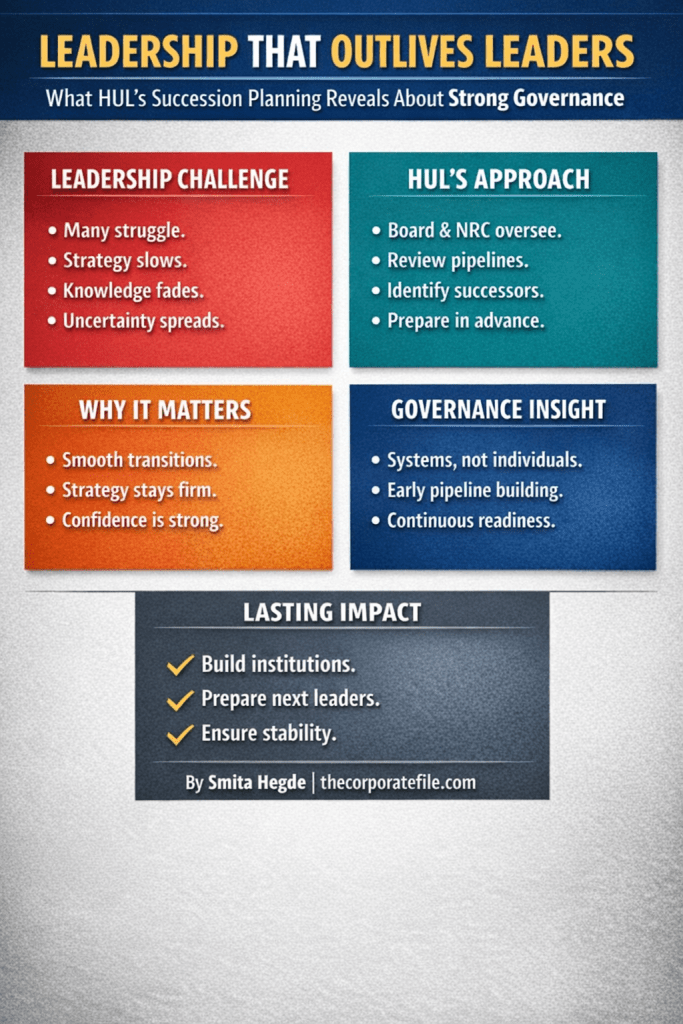
By Smita Hegde | The Corporate File
Disclaimer: Prepared solely for academic and educational purposes. This does not constitute investment advice, professional consultation, or any recommendation.
The content is based on disclosures made in the FY 2024–25 Annual Report available on the company’s official website.
Connect on Linkedin www.linkedin.com/in/smita-hegde-90595b1b5
 The Corporate File
Leave a comment