Reading Time: 7 minutes
At a Glance
This article examines how ITC Limited uses board diversity as a governance mechanism rather than a compliance requirement. In the absence of a promoter or dominant ownership voice, the Board is structured to bring together diverse professional perspectives that collectively guide strategy, evaluate risk, and maintain long-term stewardship. The article explains how ITC’s skills matrix, committee structure, and evaluation processes transform diversity into a functional governance design that strengthens decision-making across the organisation.
What happens to corporate governance when there is no promoter at the table?
At most companies, board diversity is about balance.
At ITC, it is about replacement.
There is no ownership voice guiding long-term direction.
No promoter presence influencing strategic thought.
No concentrated control shaping decisions.
So the Board does something rare.
It uses diversity to perform the role ownership usually plays.
This is not compliance.
This is design.
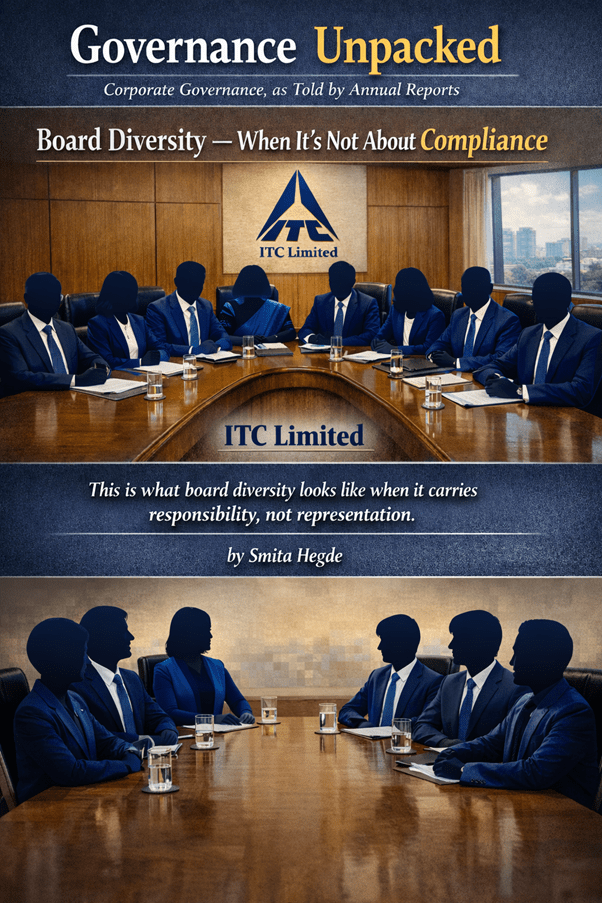
When Law Sets the Floor, Governance Builds the Ceiling
Regulation 17 of the SEBI (LODR) Regulations, 2015 prescribes the composition of the Board, including a woman director. That is the legal minimum.
At ITC, that is merely the starting point.
Because the real question here is not How many types of directors are present?
The real question is:
How do you govern a diversified conglomerate when no single owner mind exists?
The answer is visible in how diversity functions:
- Different minds replace the absent promoter voice
- Different experiences replace concentrated ownership control
- Different perspectives become the collective conscience
- Different lenses change what the Board considers “material”
- Different risk appetites balance boldness with prudence
- Different ethical anchors strengthen governance judgment
This is diversity as governance equilibrium.
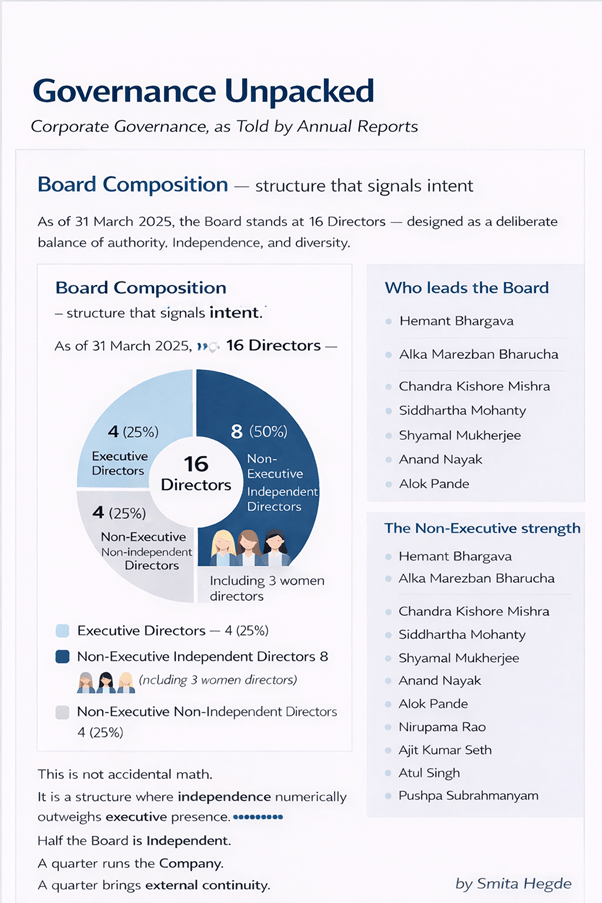
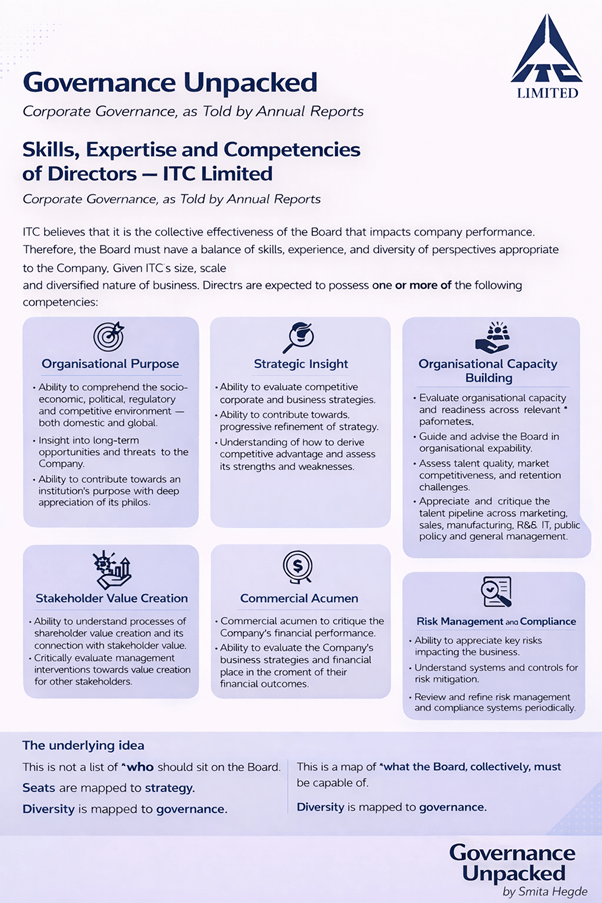
A Seat on the Board Is a Capability Requirement
ITC does not ask, Who deserves to be on the Board?
It asks, What must the Board, together, be capable of?
The skills matrix is a strategic map. The Board, collectively, must be able to:
- Read socio-economic, political, regulatory and global context
- Understand stakeholder value as a system, not a silo
- Evaluate governance philosophy, not just compliance
- Refine strategy for a diversified conglomerate
- Interpret financial outcomes with commercial sharpness
- Anticipate risk before it becomes visible
- Encourage dissent without losing cohesion
Seats are mapped to strategy. Not status. Not legacy. Not influence.
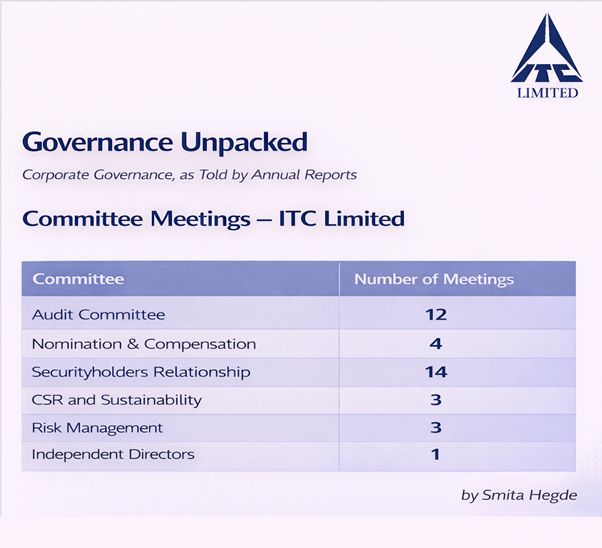
Committees: Where Diversity Gets Processed Before the Board Sees It
Let’s pause and ask something simple.
Does a matter really reach the Board for the first time when it is tabled at the meeting?
At ITC, the answer is no.
Before the Board sees anything, it has already travelled through multiple minds.
You can almost picture the journey:
discussion → filtration → escalation → decision
And who performs this filtration?
- Audit Committee
- Nomination & Compensation Committee
- Securityholders Relationship Committee
- CSR and Sustainability Committee
- Independent Directors Committee
Each committee looks at the same issue from a different lens.
By the time the Board discusses it, the matter is refined. Questioned. Viewed from multiple angles.
This is how diversity gets processed into governance quality.
Risk Is Discussed Where Strategy Is Discussed
What if risk thinking happens in the same room where strategy thinking happens?
At ITC, the Risk Management Committee includes the Chairman, Executive Directors, an Independent Director, Internal Audit, and the Chief Risk Officer.
Risk is not being reported upward.
Risk is being discussed alongside direction.
Not after decisions.
During decision thinking.
Risk is not an interruption to strategy.
It is part of strategy formation.
The Corporate Management Committee: Where Philosophy Becomes Execution
If the Board defines what must be done, who ensures how it gets done?
The Corporate Management Committee (CMC):
- Shapes business plans, policies, systems and processes
- Reviews performance against Board-approved plans
- Allocates resources
- Meets monthly, with minutes flowing to the Board
When something reaches the Board from the CMC, it comes with context, data, and background.
This is where governance philosophy turns into managerial execution.
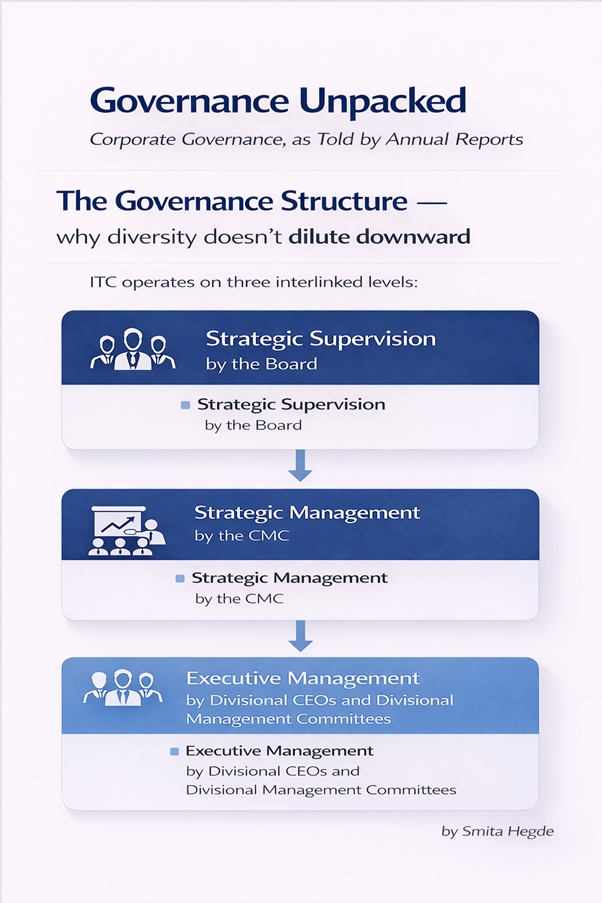
Why Diversity Does Not Dilute Down the Organisation
ITC operates on three interlinked levels:
- Strategic supervision by the Board
- Strategic management by the CMC
- Executive management by Divisional CEOs
The Board retains objectivity.
The CMC retains strategic focus.
The divisions retain speed.
This is how diversity retains its force across the organisation.
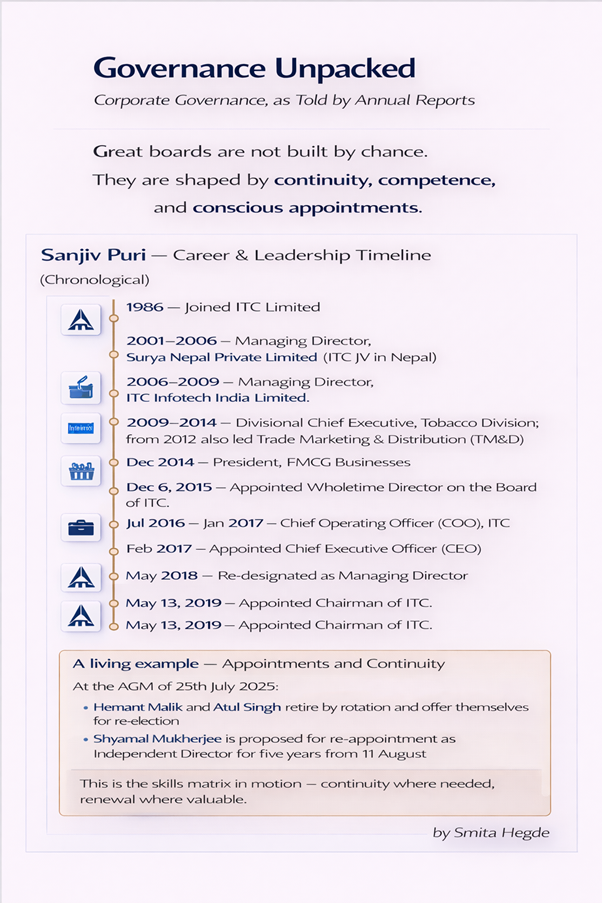
The Executive Chairman Choice — And the Higher Governance Bar It Creates
ITC chooses to have an Executive Chairman within the regulatory framework.
This raises the bar for evaluation, committee oversight, and diversity of thought.
Because influence must never overpower structure.
Remuneration — Paying for Stewardship, Not Position
Through the Nomination & Compensation Committee, remuneration reveals how responsibility is viewed.
Chairman & Managing Director and Executive Directors
- Fixed pay and perquisites
- Performance bonus linked to individual and company performance
- Long-term incentives including stock options tied to performance and sustainability goals
- Benchmarking with leading corporations
- Board and shareholder approvals within the Companies Act, 2013
This ties leadership reward to long-term value creation.
Non-Executive Directors
- Annual commission (generally uniform to reinforce collective responsibility)
- Sitting fees for meetings
They are paid to govern together, not compete.
Pay aligns with stewardship.
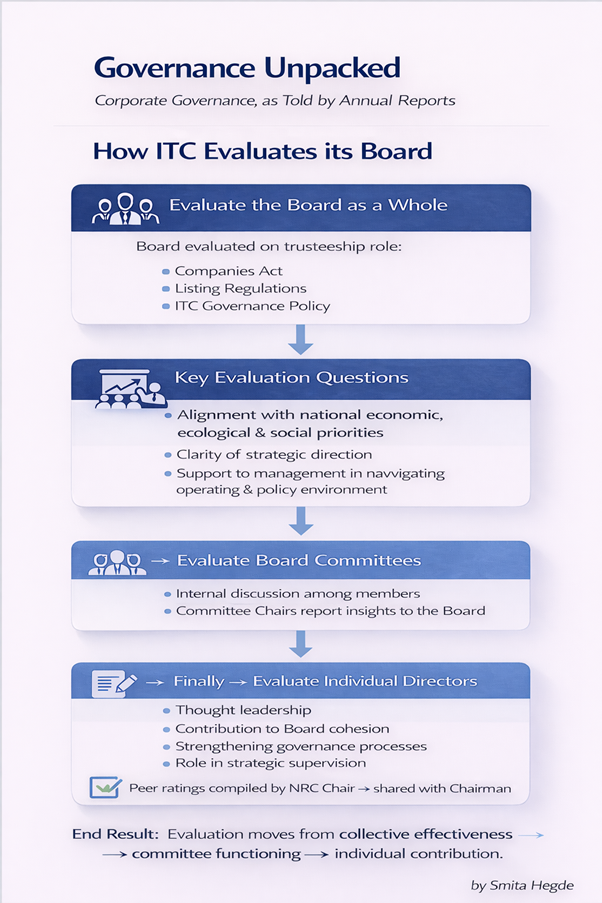
Evaluation — Where Diversity Becomes Measurable
This is not performance appraisal.
ITC evaluates:
- The Board as a collective
- Committees through internal review shared with the Board
- Individual Directors through peer evaluation
- Parameters derived from trusteeship: shareholder value, stakeholder expectations, national priorities and strategic supervision
Independent Directors evaluate objectively.
Reports flow to the Board.
Feedback is structured, not symbolic.
Culture as the Glue: The Code of Conduct
Built on:
- Good corporate governance
- Good corporate citizenship
- Exemplary personal conduct
This ensures diversity does not become disagreement, and authority does not become dominance.
The Key Takeaway
Author’s Note
While writing about ITC Limited, I deliberately return to three design choices:
- why diversity does not dilute down the organisation,
- why the Chair being executive actually raises the governance bar, and
- why the Corporate Management Committee plays such a critical role.
This is intentional.
Because these three together reveal something that is easy to miss:
At ITC, diversity is not about who sits on the Board.
It is about what the Board is structurally designed to achieve.
In the absence of a promoter voice, the company cannot rely on ownership instinct to guide long-term direction. So the Board is designed in a way where different minds collectively perform that role.
The Executive Chairman structure makes this balance even more necessary. Influence exists at the top — and therefore governance, committees, and diversity must be strong enough to balance it.
And the Corporate Management Committee completes the picture. It ensures that diverse thinking at the Board level does not remain discussion, but becomes plans, systems, and execution across the organisation.
I highlight these because they show that, here, diversity is not representational or symbolic.
It is structural, functional, and Pervasive.
It is how governance, in the absence of ownership power, travels through the company.
Disclaimer: Prepared solely for academic and educational purposes. This does not constitute investment advice, professional consultation, or any recommendation. The content is based on disclosures made in the FY 2024–25 Annual Report available on the company’s official website. Policy Reference: Policy descriptions and governance references mentioned in this article are derived from disclosures available on the official website of the company.
- Board Diversity
- Board Independence
- C-Suite Succession
- ITC
- leadership
- Promoter vs Non-Promoter Governance
- succession planning
Connect on Linkedin www.linkedin.com/in/smita-hegde-90595b1b5
 The Corporate File
Leave a comment